Putin Holds Tank-Free Victory Day Parade as U.S.-Brokered Three-Day Ceasefire With Ukraine Takes Hold
For the first time in nearly two decades, no heavy hardware crossed Red Square — and a 1,000-for-1,000 prisoner swap began at dawn at the Kolotilovka–Pokrovka crossing.

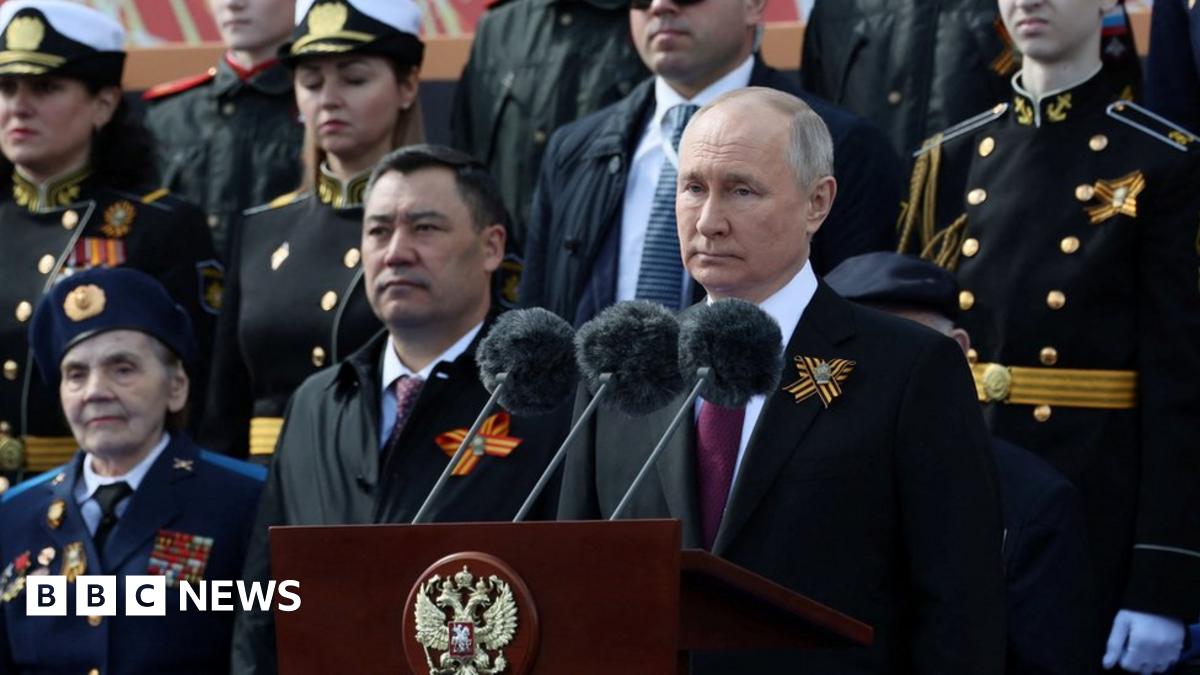
MOSCOW — Russian President Vladimir Putin presided over the most pared-back Victory Day parade of his quarter-century rule on Saturday, watching a single column of soldiers march across Red Square without a single tank, missile launcher or armored vehicle in sight — the first time in nearly two decades that the Kremlin's marquee military pageant has gone forward without heavy hardware. The shrunken spectacle unfolded on the opening morning of a U.S.-brokered three-day ceasefire with Ukraine that took effect at midnight Moscow time.
The truce, announced Thursday by President Donald Trump and confirmed by both Kyiv and Moscow, runs through May 11 and is paired with a 1,000-for-1,000 prisoner exchange that began at dawn at the Kolotilovka–Pokrovka crossing on the Russia-Ukraine frontier. "We believe that human life is far more valuable than any anniversary 'celebration,'" Ukrainian President Volodymyr Zelenskyy said in a presidential decree issued late Friday, in which he indicated Kyiv would honor a pause but reserved the right to respond to any Russian violation. Russia's defense ministry, in turn, warned that "if the Kyiv regime attempts to implement its criminal plans" during Victory Day, "the Russian Armed Forces will launch a retaliatory, massive missile strike on the center of Kyiv."
The scaled-back parade was the most visible sign yet of the toll the war has taken on Russia's conventional arsenal. Western analysts who track the Victory Day order of battle said Moscow had simply run out of intact tanks to roll out. The traditional Yars and Iskander launchers, the centerpieces of past parades, were nowhere to be seen. Instead, Putin watched a procession of roughly 11,000 troops, a single Soviet-era T-34 tank that has anchored every parade since 1965, and a flyover that was reduced to a small handful of aircraft. The Aerospace Forces' signature Su-57 stealth fighter — featured prominently in 2024 — did not appear.
Foreign attendance was thinner than last year. Chinese President Xi Jinping took the seat of honor at Putin's right hand, and the leaders of Belarus, Kazakhstan, Cuba, Venezuela and Burkina Faso were on the reviewing stand. Notable in their absence were the leaders of Serbia, Hungary and several Central Asian states whose attendance Moscow had advertised in earlier weeks. The reviewing stand was ringed by an unusually heavy security cordon, including additional Pantsir air defense systems atop nearby buildings — a precaution against the long-range Ukrainian drones that have repeatedly reached Moscow over the past year.
The ceremony marked the 81st anniversary of the Soviet defeat of Nazi Germany. Putin used his speech to repeat the Kremlin's framing of the war in Ukraine as a continuation of that earlier struggle against fascism, and warned, without elaboration, that Russia's nuclear forces remained on "a state of constant readiness." He thanked allied leaders for attending and said the country would "never forget" its fallen soldiers — a phrase he has used annually since assuming the presidency in 2000.
U.S. officials, speaking on background, said the three-day pause is being treated as a confidence-building step rather than a step toward a comprehensive deal. The talks remain stalled over the territorial status of Donetsk and Luhansk, and Trump told reporters Friday at the White House that he hopes the ceasefire "can be extended" but "we'll see what they do." By midday Saturday, Ukrainian officials reported no air-raid alerts in Kyiv for the first morning in 41 days — a brief, fragile silence over a war now in its third year.