Physicists Solve Fusion Mystery: Plasma Rotation Drives Tokamak Particle Imbalance
Breakthrough discovery explains why escaping plasma particles hit one side of fusion exhaust systems harder than the other, crucial for reactor design.

Physicists at the Department of Energy's Princeton Plasma Physics Laboratory have solved a long-standing puzzle in nuclear fusion research: why plasma particles inside a tokamak reactor consistently strike the inner divertor target far more heavily than the outer one — an asymmetry that has plagued reactor design for decades and that, until now, lacked a convincing explanation.
The answer, reported in Physical Review Letters, comes down to plasma rotation. When fusion plasma inside a tokamak spins at 88.4 kilometers per second — a speed typical of the rotating plasma in experimental reactors — it combines with cross-field particle drift to channel a disproportionate share of particles toward the inner divertor wall rather than distributing them symmetrically between inner and outer targets. The finding, led by Eric Emdee, an Associate Research Physicist at PPPL, resolves a discrepancy between what simulations predicted and what experiments consistently showed.
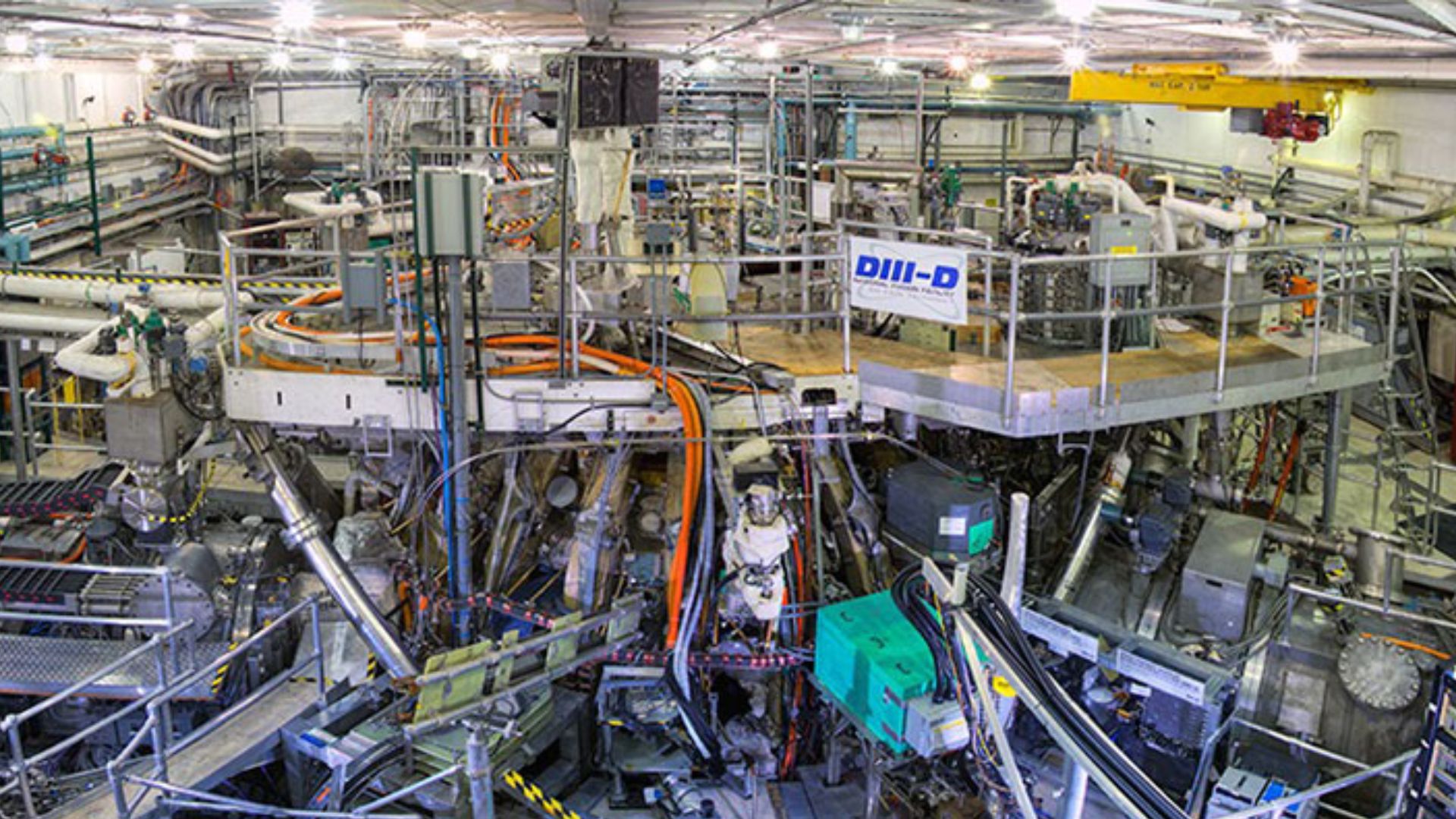
The research was conducted using data from the DIII-D tokamak in San Diego, California — the largest operating fusion research device in the United States — and modeled using the SOLPS-ITER simulation code, a standard computational tool for predicting plasma behavior in fusion reactors. The team ran four different test scenarios, toggling plasma rotation and cross-field drift on and off independently to isolate the contribution of each effect. Only when both rotation and drift were active together did the simulations reproduce the asymmetric particle distribution seen in actual experiments.
"There's cross-field flow, where particles drift sideways across magnetic field lines, and parallel flow, where they travel along those lines," Emdee explained. The interplay between these two flows — each present in real fusion plasma — is what drives particles preferentially inward. The divertor is a critical component at the base of a tokamak that handles the exhaust of plasma particles and heat; uneven particle loading accelerates erosion of the inner wall and limits reactor lifetimes.
The PPPL team included Laszlo Horvath, Alessandro Bortolon, George Wilkie, and Shaun Haskey from Princeton, alongside Raúl Gerrú Migueláñez from MIT and Florian Laggner from North Carolina State University — a collaboration spanning several leading US fusion research institutions.
For fusion reactor engineers, the finding has immediate practical implications. The ITER experiment under construction in southern France — the largest tokamak ever built, designed to demonstrate the scientific feasibility of fusion power — and planned commercial fusion reactors need to manage divertor particle loads precisely to ensure long operational lifetimes. Now that the mechanism driving the asymmetry is understood, designers can account for it directly in divertor geometry and magnetic field configurations, rather than treating it as an empirical variable to be tuned by trial and error. It is the kind of foundational result that fusion science has spent decades working toward: not a record-breaking plasma temperature or a new energy milestone, but a solved equation that makes every subsequent calculation more reliable.