Physicists Finally Observe Migdal Effect After 87 Years, Opening New Path to Detect Light Dark Matter
A Chinese research team bombarded 800,000 candidate events with neutrons and identified six unmistakable two-track signals of the quantum process predicted by Soviet physicist Arkady Migdal in 1939 — a five-sigma confirmation.

Physicists in China have achieved something that eluded experimental science for more than 87 years: the direct observation of the Migdal effect, a quantum mechanical process first predicted in 1939 by Soviet physicist Arkady Migdal that could fundamentally transform the search for dark matter — the invisible substance believed to make up roughly 27 percent of the universe's total mass and energy budget, yet never directly detected despite decades of increasingly sophisticated experiments.
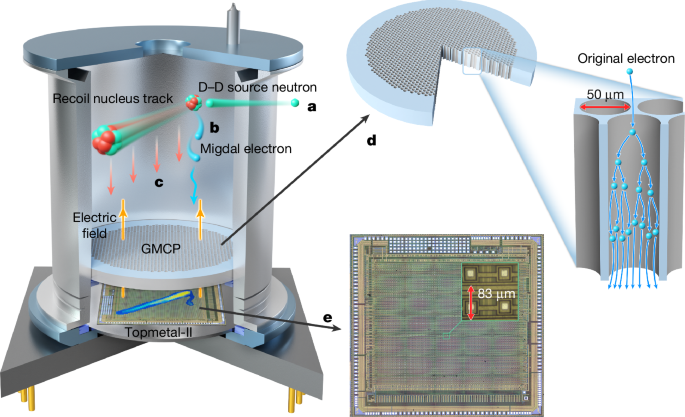
The discovery, published January 15 in the journal Nature, was led by researchers at the University of Chinese Academy of Sciences in collaboration with Shanghai Jiao Tong University. The Migdal effect describes what happens when a neutral particle, such as a neutron, strikes an atomic nucleus: the violent jolt causes the nucleus to recoil so rapidly that the atom's surrounding electric field cannot keep pace. In the instant that follows, an orbiting electron — momentarily left behind by the recoiling nucleus — is ejected from the atom entirely. This ejected electron produces a detectable electronic signal that is many times more energetic than the nuclear recoil alone.
The experimental setup required extraordinary precision. The team used a gas pixel detector with integrated microchip readout technology to analyze more than 800,000 candidate events produced by bombarding gas molecules with neutrons. From that enormous dataset, they identified six clear events displaying the distinctive two-track signature of the Migdal effect: one track from the recoiling nucleus and a simultaneous second track from the ejected electron, both originating from the same spatial point. The result achieved five-sigma statistical confidence — the gold standard in particle physics, equivalent to a one-in-3.5-million probability that the signal is a statistical fluctuation rather than a real phenomenon. 'Directly observing the Migdal effect in nuclear experiments has been a long-standing challenge in the field,' said Professor Zheng Yangheng of UCAS, one of the paper's lead authors. 'This is not just a confirmation of a theoretical prediction made nearly a century ago. It opens an entirely new detection channel for dark matter.'
The reason the discovery matters so profoundly for dark matter research comes down to energy thresholds. Conventional dark matter detectors — liquid xenon experiments like LUX-ZEPLIN and PandaX, as well as solid-state crystal detectors — are designed to measure the nuclear recoil energy deposited when a hypothetical dark matter particle strikes an atomic nucleus. The problem is fundamental: if dark matter particles are lighter than a proton — masses in the megaelectronvolt range that some theoretical models predict — the recoil energy they impart is so small it falls below the detection threshold of existing instruments. The particles would pass through any detector humanity has built, leaving no measurable trace. The Migdal effect changes the arithmetic. By converting that otherwise invisible nuclear recoil into a much larger and measurable electronic signal, it extends the reach of dark matter detectors to particle masses orders of magnitude lower than was previously accessible. Physicist Yu Haibo of UC Riverside, who was not part of the UCAS team but is an expert in rare event detection, described the advance as 'giving dark matter detectors new eyes.'
Professor Liu Jianglai of Shanghai Jiao Tong University, who leads the PandaX dark matter experiment at the China Jinping Underground Laboratory, said the team plans to incorporate Migdal-sensitive readout capabilities into the forthcoming PandaX-xT upgrade. The next generation of dark matter experiments — including the proposed XLZD consortium detector in the United States — is expected to be designed from the ground up to exploit the Migdal channel. For the first time, the light dark matter mass range that was once considered simply inaccessible is now on the experimental map.