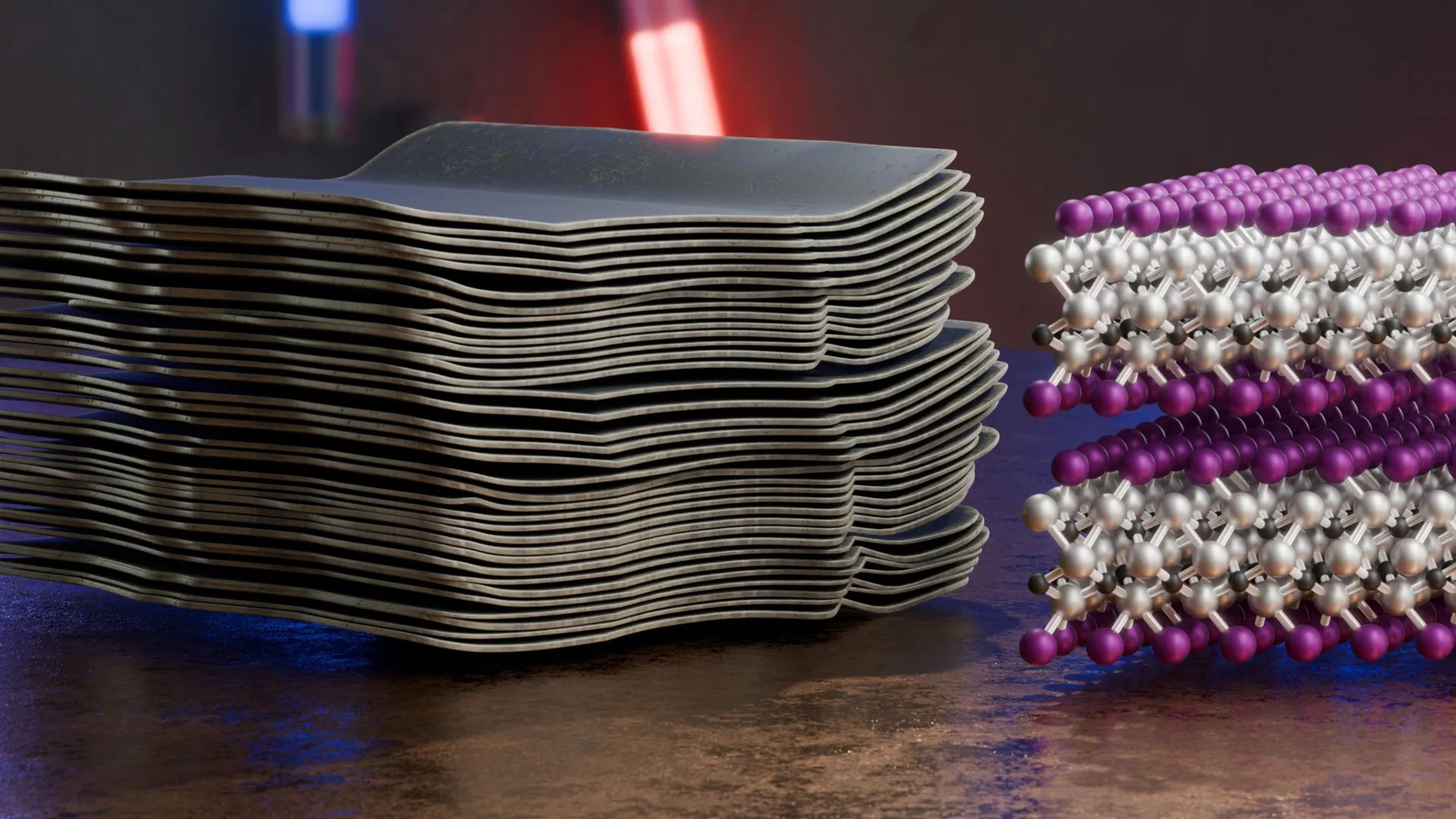
Physicists Confirm 50-Year-Old Prediction — Observing Nobel-Prize-Winning Magnetic Vortices in a Real Material for the First Time
A University of Texas at Austin team cooled an atomically thin sheet of nickel phosphorus trisulfide to watch it spontaneously form the paired magnetic vortex structures predicted by the 1970s BKT theory — confirming that topologically protected magnetic states can exist in actual crystals, with potential implications for next-generation data storage.

Physicists at the University of Texas at Austin have confirmed, for the first time in a single material system, a 50-year-old theoretical prediction about exotic magnetic vortices in atomically thin crystals — a discovery that represents a landmark in the physics of two-dimensional materials and opens the door to a new class of ultracompact nanoscale technologies built on topological magnetic control. The experiment, led by Professor Edoardo Baldini of the Texas Quantum Institute, observed the full predicted sequence of magnetic phases in a single-atom-thick sheet of nickel phosphorus trisulfide (NiPS₃), including the elusive Berezinskii-Kosterlitz-Thouless (BKT) phase — a quantum magnetic state that theorists first predicted in the 1970s and whose discoverers shared the 2016 Nobel Prize in Physics, but which had never before been fully demonstrated in a single material.
The BKT phase, named for physicists Vadim Berezinskii, John Michael Kosterlitz, and David Thouless, is a quantum state in which magnetic moments in a two-dimensional material spontaneously organize into paired vortex structures. In each pair, one vortex rotates clockwise and its partner rotates counterclockwise, the two remaining tightly linked at nanometer scales within a single atomic layer. These paired vortices are described as "topologically protected" — meaning they are inherently stable against disruption by thermal fluctuations or external perturbations, a property that has made them attractive candidates for extremely stable data storage or nanoscale logic devices since the theory was first published. The challenge was that no one had observed them in a real magnetic material under experimentally controlled conditions, calling into question whether the beautiful theory ever had a practical analogue in nature.
The UT Austin team solved the problem by cooling an atomically thin sheet of NiPS₃ to between -150°C and -130°C and probing its magnetic state at different temperatures using ultrafast optical techniques. At the higher end of this temperature range, they observed the BKT phase with its characteristic paired vortex structure. At lower temperatures, the material transitioned into a distinct "six-state clock ordered phase," in which the magnetic moments aligned in one of six equivalent symmetrical directions across the crystal — a second discrete ordered state predicted by the same theoretical model. Observing this complete two-step sequence of phase transitions in a single material system was the experimental breakthrough; previous work had seen hints of one phase or the other in different materials, but never the full theoretically predicted sequence in one place.
The material NiPS₃ was ideally suited to the experiment because of its crystal symmetry: each nickel atom's magnetic moment can naturally point in one of precisely six equivalent directions, which is exactly the discrete symmetry structure required by the six-state clock model. The research was co-led by Dong Seob Kim and Frank Y. Gao, with senior co-authors including Allan MacDonald — one of the world's most influential condensed matter theorists and the co-discoverer of the superconducting properties of twisted bilayer graphene — and Xiaoqin Li, both of the Texas Quantum Institute. The work was published in a leading physics journal and accompanied by a ScienceDaily release that described it as the first complete experimental confirmation of the two-dimensional six-state clock model.
The immediate scientific impact is the proof that BKT vortices — and the topological protection they carry — exist in real magnetic materials at reachable temperatures and not merely in theoretical models. The longer-term technological implications could be more significant. The vortex pairs in NiPS₃ are confined to a single atomic layer, making them potentially the smallest controllable magnetic structures ever demonstrated in a material. Researchers said that if scientists can find ways to stabilize similar phases at room temperature — a target they described as challenging but not impossible — they could serve as the basis for magnetic data storage that requires no external field for stability and occupies a fraction of the space of current storage media. "What we've confirmed is that the theoretical framework built 50 years ago wasn't just elegant mathematics," Baldini said. "It describes something real that we can observe and eventually engineer."