Physicist Derives Zeeman Effect Using Classical Physics and Zero-Point Radiation
Timothy Boyer's new paper challenges the conventional view that magnetic splitting of spectral lines requires quantum mechanics
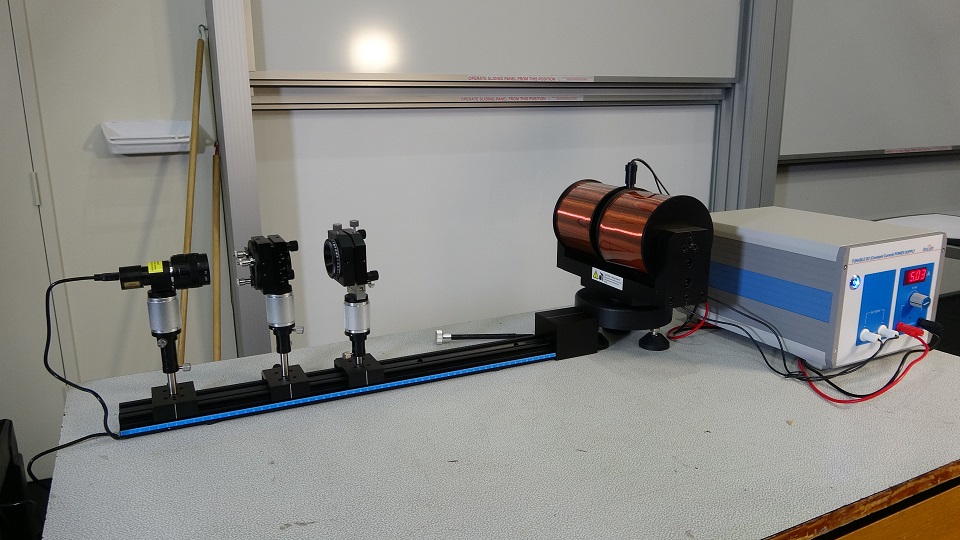
A new paper posted to the arXiv preprint server attempts something most physicists would consider impossible: deriving the Zeeman effect — the splitting of atomic spectral lines in a magnetic field — using purely classical physics augmented by classical zero-point radiation.
Timothy H. Boyer, a longtime proponent of stochastic electrodynamics (SED), published the eight-page paper on March 13, treating the electron in hydrogen as a classical charged particle moving in a Coulomb potential. Rather than invoking quantum mechanics, Boyer incorporates classical zero-point radiation — the idea that electromagnetic radiation with a specific spectral distribution pervades all of space even at zero temperature — to reproduce results traditionally considered hallmarks of quantum theory. The paper addresses "space quantization" from the old quantum theory of Bohr and Sommerfeld, the Sommerfeld relativistic correction, and even the Stern-Gerlach experiment, which has long been cited as definitive proof of angular momentum quantization.
The Zeeman effect, first observed by Dutch physicist Pieter Zeeman in 1896, was one of the early phenomena that propelled the development of quantum mechanics. The splitting of hydrogen's spectral lines in an external magnetic field is conventionally explained through quantized orbital angular momentum and its discrete projections. Boyer's approach instead relies on SED, a research program dating to the 1960s that attempts to recover quantum-like behavior from classical electrodynamics by adding a background of random classical radiation with an energy spectrum of ½ℏω per mode — the same zero-point energy spectrum predicted by quantum field theory, but treated as a real classical field.
Boyer has spent decades exploring whether SED can reproduce results typically attributed to quantum mechanics, including the blackbody radiation spectrum, the hydrogen ground state, and van der Waals forces. His latest work extends this program to one of quantum theory's most celebrated predictions. The paper, classified under both classical physics and quantum physics on the arXiv, has not yet undergone peer review.
The work is likely to draw skepticism from the broader physics community, where SED remains a minority research program. Critics have long argued that while SED can reproduce certain quantum results in limited contexts, it fails to capture the full structure of quantum mechanics, particularly entanglement and multi-particle correlations. Nonetheless, Boyer's persistent efforts represent one of the most sustained attempts to probe the boundary between classical and quantum physics, and his latest result — if it withstands scrutiny — would add another quantum phenomenon to the classical ledger.


