Physicists Confirm 87-Year-Old Quantum Prediction for the First Time, Unlocking New Way to Hunt Dark Matter
Chinese scientists directly observed the Migdal effect — the ejection of electrons during nuclear recoil — at 5-sigma significance, validating a key theoretical tool for detecting light dark matter.
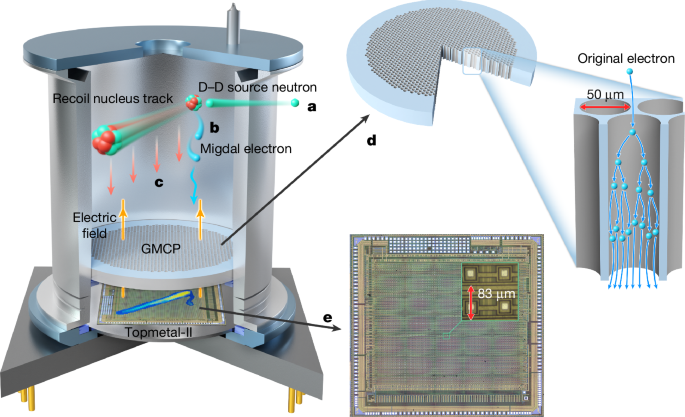
Chinese physicists have achieved the first direct experimental observation of the Migdal effect — a quantum mechanical process predicted 87 years ago but never definitively confirmed — in a result that simultaneously closes one of particle physics' longest-standing experimental gaps and opens a powerful new avenue for searching for dark matter, the invisible substance thought to make up 27% of the universe. The findings, published in Nature, describe how a team led by researchers at the University of the Chinese Academy of Sciences used an ultra-sensitive detector to capture the fleeting signal produced when a neutron strikes an atomic nucleus so hard that the recoil energy is partially transferred not just to the nucleus but to an electron orbiting it — ejecting that electron from the atom in a process distinct from ordinary nuclear recoil.
The Migdal effect was proposed in 1939 by Soviet physicist Arkady Migdal, who calculated that when a nucleus receives a sudden violent impulse from a colliding particle, the electrons bound to that nucleus cannot instantaneously adjust to the new nuclear position. For a fraction of a second, the electron cloud is effectively left behind, creating a temporary relative motion between nucleus and electrons. In some cases, Migdal showed, this relative motion transfers enough energy to knock an electron free from the atom entirely — producing an ionization signal separate from the nuclear recoil. This electron signal is far easier to detect in certain detector technologies than the nuclear recoil alone, making Migdal emission potentially crucial for spotting very light dark matter particles that would otherwise be too gentle to register.
The experimental challenge was immense. Of the nearly one million events recorded during the experiment, only six candidate events matched the specific signal signature predicted for Migdal emission during neutron-nucleus collisions. Identifying those six events against the background noise required a newly developed detector combining a micro-pattern gas detector with a pixelated electronic readout chip — effectively a camera capable of photographing the moment a single electron is released from a single atom during a nuclear collision. The team's final result carries a statistical significance of 5 sigma, the gold standard in particle physics for claiming a discovery, equivalent to less than a one-in-a-million probability that the observation occurred by chance.
The dark matter connection is the finding's most immediate practical application. Current dark matter detectors are exquisitely sensitive to particles heavy enough to kick a nucleus — but particles at the lighter end of the theoretically predicted dark matter mass range would produce nuclear recoils too faint to detect above background noise. Migdal emission could change this. If a light dark matter particle strikes an atomic nucleus and triggers a Migdal electron, that electron's ionization signal would be large enough to detect even when the nuclear recoil itself is invisible. Experimental physicists at several major dark matter search projects — including LUX-ZEPLIN in South Dakota and the PandaX-4T detector in China's Jinping Underground Laboratory — have been waiting for experimental validation of the Migdal effect before incorporating Migdal-based detection techniques into their sensitivity analyses. With the observation now confirmed, those teams can recalibrate their searches to extend into mass ranges that were previously considered inaccessible.
Beyond dark matter, the result confirms that quantum mechanics' predictions about atomic behavior under extreme perturbation remain accurate even in regimes that had never been tested. Migdal's 1939 calculation was derived using the sudden approximation — a framework that assumes the perturbation is so rapid that electrons can be treated as stationary during the initial nuclear impulse. This approximation was theoretical and untested. The Chinese team's confirmation provides the first experimental validation of the sudden approximation under neutron bombardment conditions, reinforcing the theoretical foundations used in nuclear physics calculations from weapons design to reactor safety. It is the kind of result that appears once in a generation: a prediction made in the final years before World War II, left unconfirmed through decades of experimental progress, and finally validated by a detector technology that didn't exist when the prediction was first written down.