Physicists Stretch a Magnetic Ripple's Life 100-Fold, Clearing a Path to Coin-Sized Quantum Computers
By cooling ultra-pure crystals to a whisker above absolute zero, a Vienna-led team kept magnons alive for 18 microseconds — long enough, they say, to carry quantum information the way today's best qubits do.

Physicists have found a way to keep a tiny magnetic ripple alive nearly 100 times longer than ever before, a breakthrough that could shrink quantum computers from room-sized machines to devices no larger than a one-cent coin.
The ripples in question are called magnons — waves in the magnetization of a solid magnetic material, much like the rings that spread across a pond after a stone is dropped in. Because their wavelengths can be squeezed down to the nanometer scale, magnonic circuits could in principle be packed onto a chip as small as those inside a smartphone. The catch has always been their fragility: until now, magnons survived for only a few hundred nanoseconds at best, far too fleeting to reliably carry quantum information.
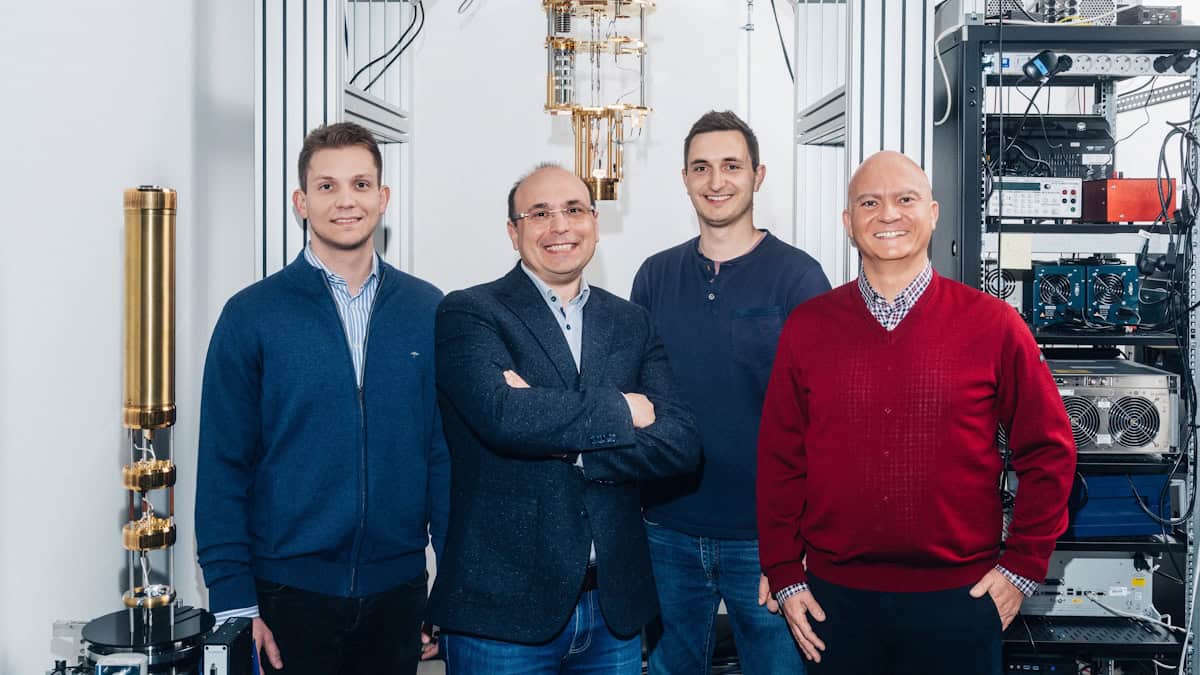
An international team led by researchers at the University of Vienna changed that. By generating short-wavelength magnons and placing extremely pure spheres of yttrium iron garnet — a crystal prized for its magnetic quality — inside a cryostat cooled to just 30 millikelvin, a hair above absolute zero, the scientists measured magnon lifetimes of up to 18 microseconds. That is almost a hundredfold improvement, and it puts magnons in the same league as the superconducting qubits used in today's leading quantum processors.
The key insight was that the barrier had never been fundamental physics at all. "The lifespan of magnons is not ultimately limited by the laws of physics, but by the quality of the material they travel through," the team reported, showing that impurities and thermal disturbances — not any deep quantum limit — had been cutting the waves short. Freezing out those thermal processes and using near-flawless crystals let the magnons persist. The work, led by Andrii Chumak with doctoral researcher Rostyslav Serha and collaborators in the United States, Germany and Ukraine, was published in the journal Science Advances.
The payoff could be substantial. Long-lived magnons could act as a shared quantum "bus," connecting hundreds of qubits through a single pathway and doing away with much of the bulky wiring that makes current quantum computers so large. If the approach scales, the researchers say, it could help pave the way toward a practical quantum computer small enough to hold between two fingers — a striking vision for a technology that today fills entire laboratories.