Magnets That Think Like Graphene: Illinois Engineers' Breakthrough Could Shrink Wireless Chips to the Width of a Hair
Researchers at the University of Illinois have discovered that specially designed magnetic films follow the same mathematical rules as graphene's electrons — with transformative implications for wireless communications technology.
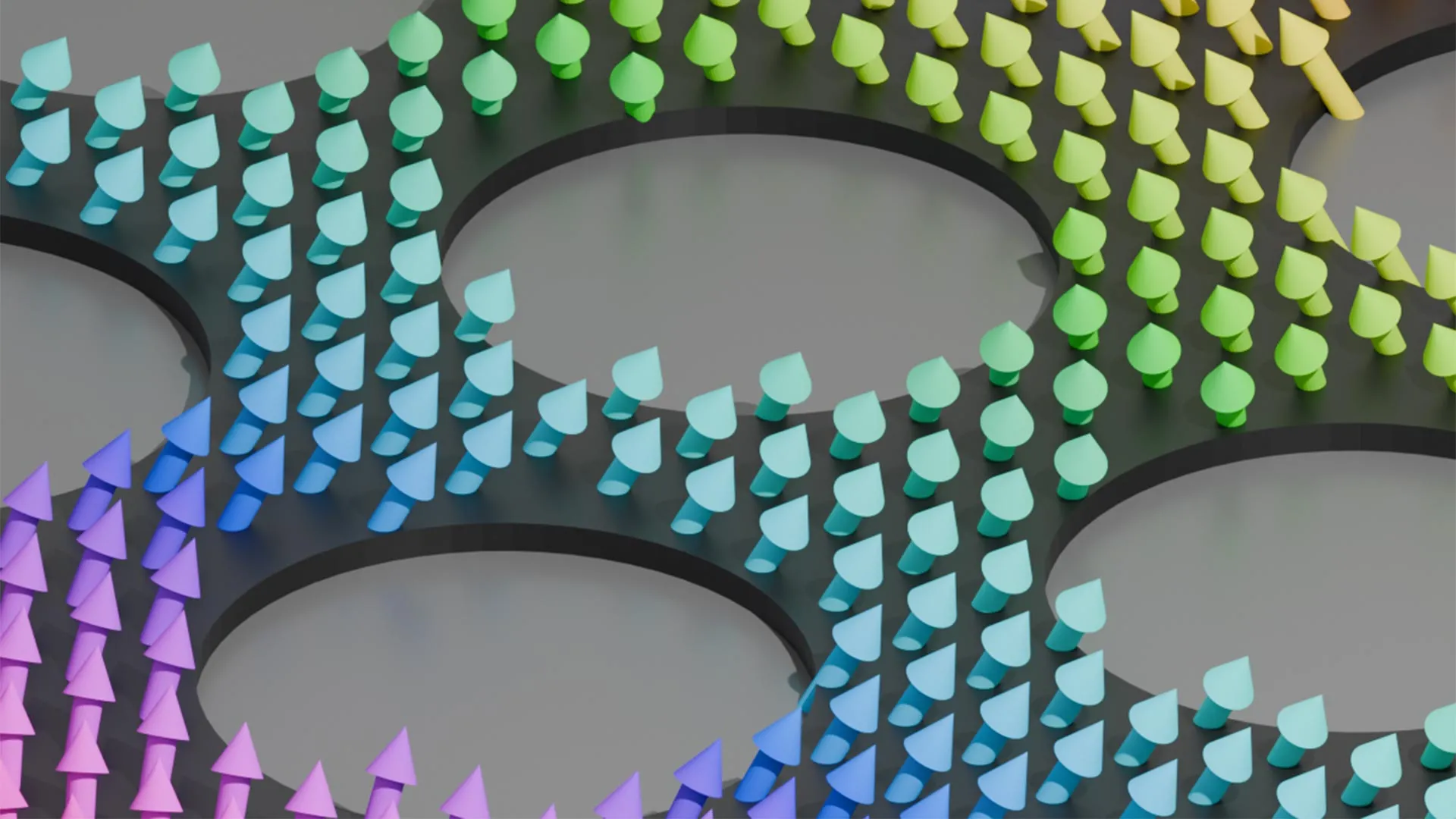
In one of the more surprising materials discoveries of the year, engineers at the University of Illinois Urbana-Champaign have demonstrated that magnetic systems can be designed to behave exactly like graphene — one of the most celebrated and intensely studied materials in modern physics — even though the two appear to have almost nothing in common. The finding, published March 8 in the journal Physical Review X, provides a powerful new framework for understanding complex magnetic materials and has immediate practical implications for miniaturizing the wireless communication components found in every cell phone and base station on the planet.
The research, led by materials science graduate student Bobby Kaman and Professor Axel Hoffmann of the Illinois Grainger College of Engineering, began with a deceptively simple structural observation: if you arrange a hexagonal pattern of tiny holes in a thin magnetic film — mimicking the honeycomb lattice structure of graphene — the magnetic disturbances traveling through that film, called spin waves, follow the same mathematical equations that govern electrons in real graphene. Graphene, a single-atom-thick sheet of carbon, is famous for producing "massless" electrons that travel at extraordinary speeds and exhibit a range of unusual quantum behaviors, including topological effects that are extraordinarily robust against disruption. The Illinois team showed that spin waves in their engineered magnetic film display nine distinct energy bands whose properties mirror graphene's electronic structure almost exactly.
"Magnonic crystals are notorious for producing an overwhelming variety of structure- and geometry-dependent phenomena, most of which are cataloged without really being understood," Hoffmann said. The new mathematical connection gives physicists and engineers a unified way to interpret the behavior of complex magnetic materials using tools and intuitions developed over two decades of graphene research — a massive shortcut that could accelerate materials design considerably. The discovery confirms a deeper unity between electronic and magnetic physics that researchers had long suspected but never demonstrated so cleanly.
The practical implications center on microwave circulators — components that allow microwave radio signals to propagate only in one direction, which are indispensable in wireless and cellular communication systems, satellite receivers, and radar. Current circulators are bulky, expensive, and difficult to integrate with microchips. The Illinois team's magnonic platform could, Hoffmann said, "allow microwave devices to be miniaturized to the micrometer scale" — a reduction from centimeter-scale components to devices smaller than a human hair. A patent application has already been filed, and the research was funded by the National Science Foundation's Illinois Materials Research Science and Engineering Center.
The broader scientific significance of the work extends beyond wireless chips. The graphene mathematical framework includes topological effects — quantum states that persist robustly even in the presence of defects or perturbations — which the Illinois team believes can now be engineered into magnetic systems using the same hexagonal-patterning approach. Topological quantum states in magnets are a growing research frontier because they could enable spintronic devices that operate reliably without the signal degradation that plagues conventional electronics. Contributors Jinho Lim and Yingkai Liu, alongside Kaman and Hoffmann, say the result demonstrates that the mathematical language of condensed matter physics can bridge seemingly unconnected areas of research — and that some of the most important discoveries come not from finding new materials, but from recognizing that very different materials are secretly speaking the same language.