Scientists Make Light Drift in Quantized Steps — A Nobel-Level Quantum Effect Achieved in Photons for the First Time
An international team achieved what once seemed impossible: photons drifting sideways in perfectly defined, quantized steps just like electrons in the quantum Hall effect — a potential new gold standard for precision measurement.
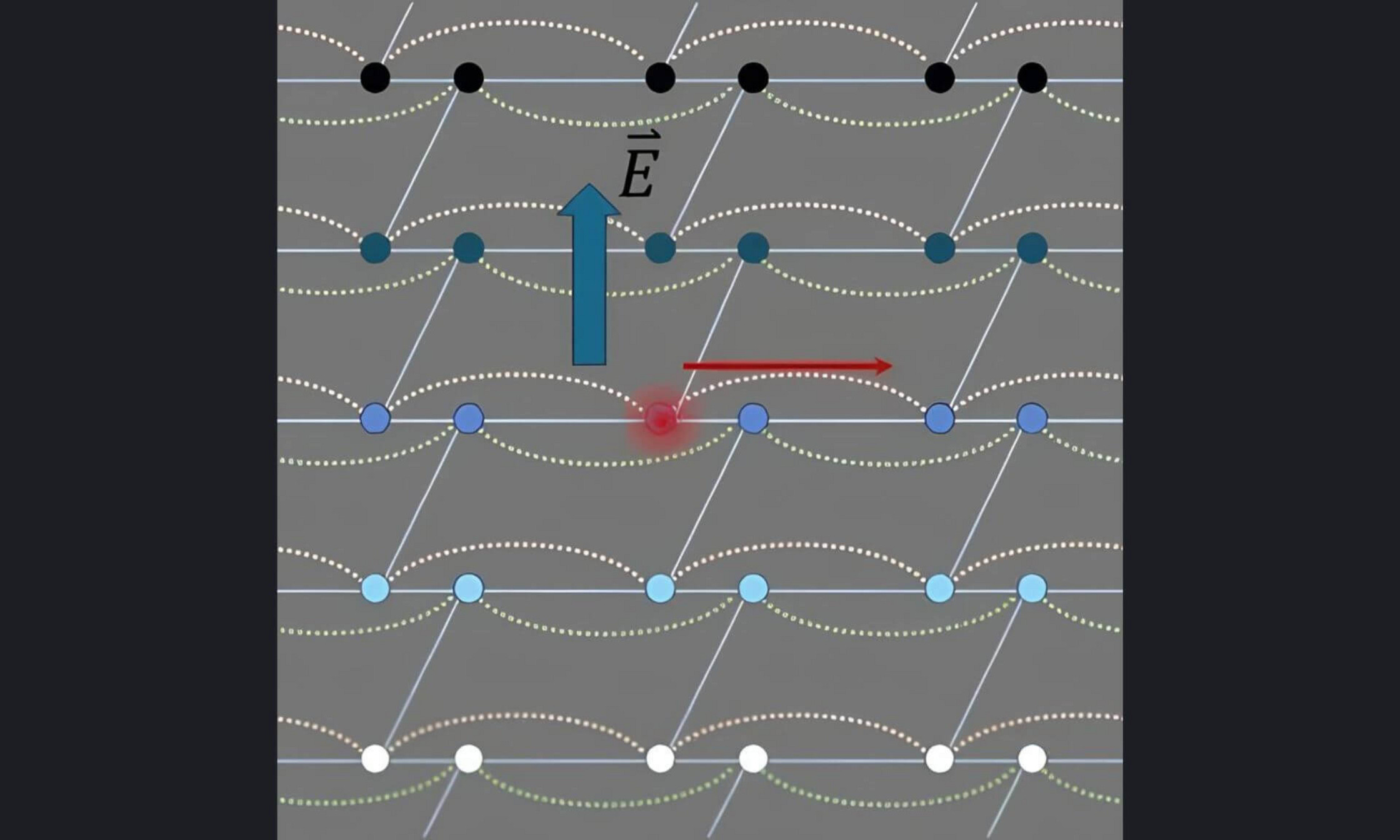
For the first time in the history of physics, scientists have observed light drifting in perfectly quantized, sideways steps — the optical equivalent of the quantum Hall effect, a phenomenon previously seen only in electrons subjected to powerful magnetic fields. The achievement, published February 5, 2026, in Physical Review X by an international team led by researchers at the Université de Montréal, could establish light as the basis for a new global standard in precision measurement and open new pathways to quantum photonic computers that are more resilient to errors than existing designs.
The quantum Hall effect — which earned Klaus von Klitzing the 1985 Nobel Prize in Physics — describes the behavior of electrons flowing along the edge of a thin conducting material in the presence of a strong magnetic field. In that configuration, electrons drift in precisely defined, quantized transverse steps that are determined entirely by fundamental constants of nature rather than by the properties of the specific material being used. This universality makes the Hall plateaus a gold standard for electrical resistance measurement; every country in the world shares an identical definition of the ohm based on the effect. The challenge has been that photons, which carry no electric charge, cannot naturally respond to magnetic fields, making it extraordinarily difficult to replicate the phenomenon with light.
The Montréal-led team overcame this barrier through advanced experimental engineering, constructing a photonic system in which photons could drift sideways in precisely defined, quantized steps analogous to those seen in electrons. "Light drifts in a quantized manner, following universal steps analogous to those seen with electrons under strong magnetic fields," said Philippe St-Jean, one of the paper's lead authors. Because these optical steps depend only on nature's fundamental constants rather than on the specific properties of the apparatus, they could serve as a universal measurement standard for optical systems — potentially complementing or eventually replacing the electronic systems currently used in metrology.
The implications extend well beyond precision measurement. In quantum information processing, one of the central challenges is making quantum systems robust against noise and errors. The quantum Hall effect in electrons naturally produces edge states that are topologically protected — immune to backscattering from impurities and defects. An optical equivalent could lead to quantum photonic systems where information-carrying photons travel along protected channels that resist disruption, addressing a key vulnerability in current photonic quantum computing architectures. Researchers also noted that even tiny deviations from perfect quantization in such a system could be detected with extreme sensitivity, opening the door to a new generation of sensors for applications ranging from navigation to biomedical imaging.
The result is the latest in a series of discoveries that are systematically extending quantum mechanical phenomena into new physical domains. Quantum spin Hall effects in acoustic systems, topological states in classical mechanical systems, and now quantized Hall drift in photonic systems all suggest that the mathematical structures underlying quantum mechanics are far more universal than was originally appreciated — a recognition that is reshaping fundamental physics research and its potential applications. The Montréal team's work was conducted in collaboration with researchers in France, the United States, and Switzerland, and is expected to generate significant follow-on experiments at photonics laboratories worldwide.