A 100-Year-Old Geometry Problem Called the Kakeya Conjecture Has Finally Been Solved
Mathematician Hong Wang and collaborator Josh Zahl proved that rotating a needle through all orientations in three dimensions requires a certain minimum volume — resolving one of the most stubborn open problems in harmonic analysis.
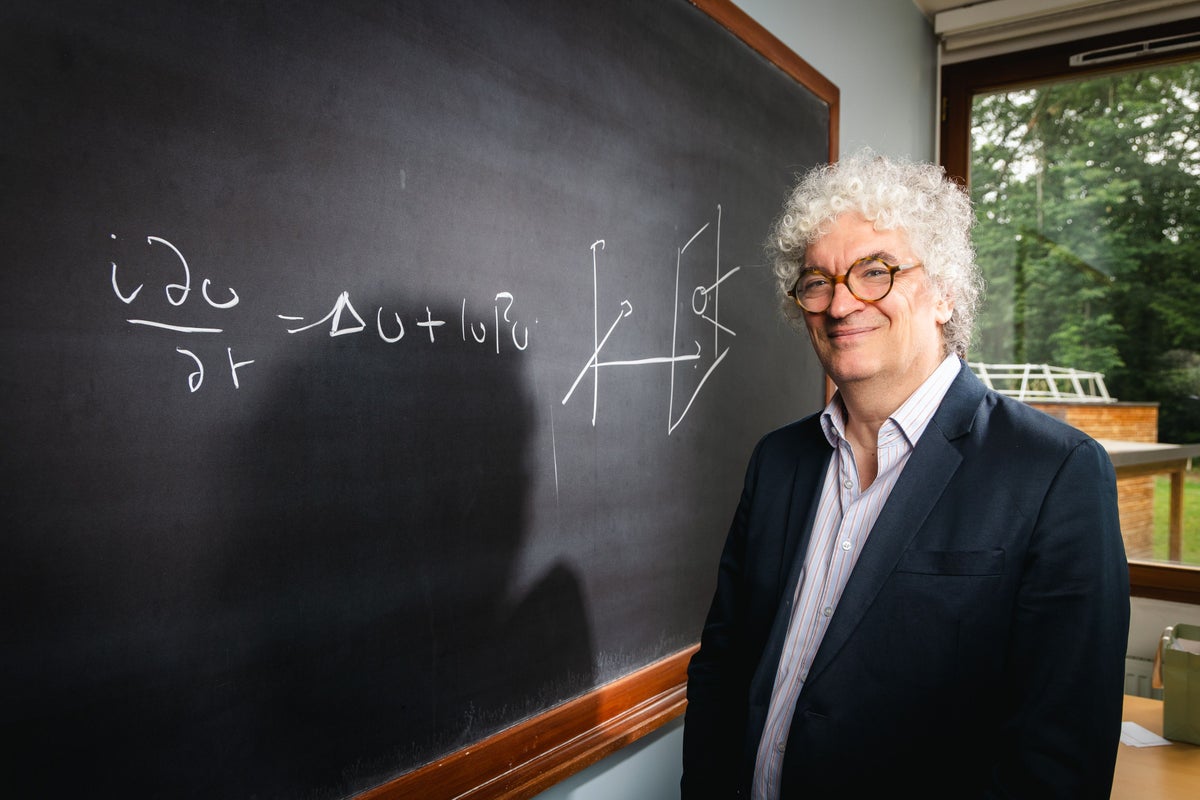
Mathematician Hong Wang of NYU's Courant Institute and the Institut des Hautes Études Scientifiques in France, working with collaborator Josh Zahl of the University of British Columbia, has resolved the three-dimensional Kakeya conjecture — one of the most famous open problems in mathematics, first posed over a century ago, with deep connections to harmonic analysis, partial differential equations, and even number theory.
The result, which earned Wang a 2026 New Horizons in Mathematics Prize as part of the Breakthrough Prize ceremony held Saturday at Barker Hangar in Santa Monica, California, answers a deceptively simple-sounding geometric question: if you have a needle of unit length in three-dimensional space, and you want to rotate it so that it points in every possible direction at least once, what is the smallest volume the needle must sweep through? The problem was first posed by Japanese mathematician Sōichi Kakeya in 1917, and in two dimensions it has a surprising answer: you can rotate the needle through all directions while sweeping a region of area exactly zero, using a specific type of fractal-like construction. This counterintuitive result in two dimensions prompted mathematicians to ask what happens in three and higher dimensions.
The three-dimensional version has resisted proof for decades despite intense attention from leading analysts. The conjecture holds that in three dimensions, the set swept by the rotating needle must have full dimension — it cannot be "thin" in any rigorous sense, even though it can have measure zero. More precisely, the Kakeya set must have Hausdorff dimension equal to three. This sounds like it should be straightforward — the set must occupy a three-dimensional region of space — but proving it has required developing entirely new mathematical machinery. Wang and Zahl's proof, described by colleagues as a technical tour de force, established the result through deep methods in multilinear harmonic analysis, combining tools from combinatorics and geometric measure theory.
The Kakeya conjecture is not merely a puzzle about rotating needles. It sits at the intersection of several important mathematical domains. The Fourier restriction problem — which asks how certain frequency information can be concentrated — is intimately linked to Kakeya, and the restriction conjecture implies the Kakeya conjecture. Progress on Kakeya has historically driven progress on related questions about how solutions to wave equations and Schrödinger equations can concentrate or disperse. Wang's earlier work, cited in her prize citation alongside the Furstenberg set conjecture and local smoothing conjecture, collectively advanced a cluster of interrelated problems in harmonic analysis that mathematicians have worked on for decades.
Hong Wang received the New Horizons in Mathematics Prize — a $100,000 early-career award — alongside two other prize winners: Otis Chodosh of Stanford, for work on minimal surfaces and scalar curvature, and Vesselin Dimitrov and Yunqing Tang of Caltech and UC Berkeley, for a proof of the Atkin-Swinnerton-Dyer unbounded denominators conjecture and new irrationality results for special values of mathematical functions called Dirichlet L-series. The latter result was described by prize organizers as the first irrationality result of its kind in 45 years. The main Breakthrough Prize in Mathematics — worth $3 million — went to French mathematician Frank Merle for his work on nonlinear evolution equations. The ceremony marked the fifteenth year of the prizes, which have now distributed more than $340 million in cumulative awards across physics, life sciences, and mathematics.