Astronomers Discover 33,000 Giant Hydrogen Halos Around Ancient Galaxies, Solving a Decade-Long Mystery
The HETDEX survey has increased the known number of these cosmic structures tenfold, revealing the vast hydrogen reservoirs that powered galaxy formation 10-12 billion years ago.

Astronomers using the Hobby-Eberly Telescope Dark Energy Experiment, known as HETDEX, announced this week the discovery of more than 33,000 hydrogen halos surrounding galaxies in the early universe — the largest catalog of such structures ever assembled and a dataset that is fundamentally changing scientists' understanding of how gas flows into and out of galaxies during the epoch when most of the universe's stars were being formed. The halos, detected through the emission of Lyman-alpha ultraviolet radiation from hydrogen gas, surround galaxies observed as they existed between 1.9 and 3.5 billion years after the Big Bang, during the period cosmologists call cosmic noon, when star formation in the universe was at its peak.
The Lyman-alpha halo is produced when ultraviolet light from a galaxy's interior — generated by young, hot stars and by the accretion of gas onto central black holes — escapes from the dense core and illuminates the surrounding circumgalactic medium, the diffuse reservoir of gas that surrounds galaxies and serves as both the fuel for future star formation and the repository for gas expelled by supernovae and stellar winds. The structure and extent of these halos encode information about how gas circulates between the intergalactic medium, the galaxy's outer reservoir, and the star-forming interior — a cycle that determines how quickly galaxies grow and why they eventually stop forming stars.
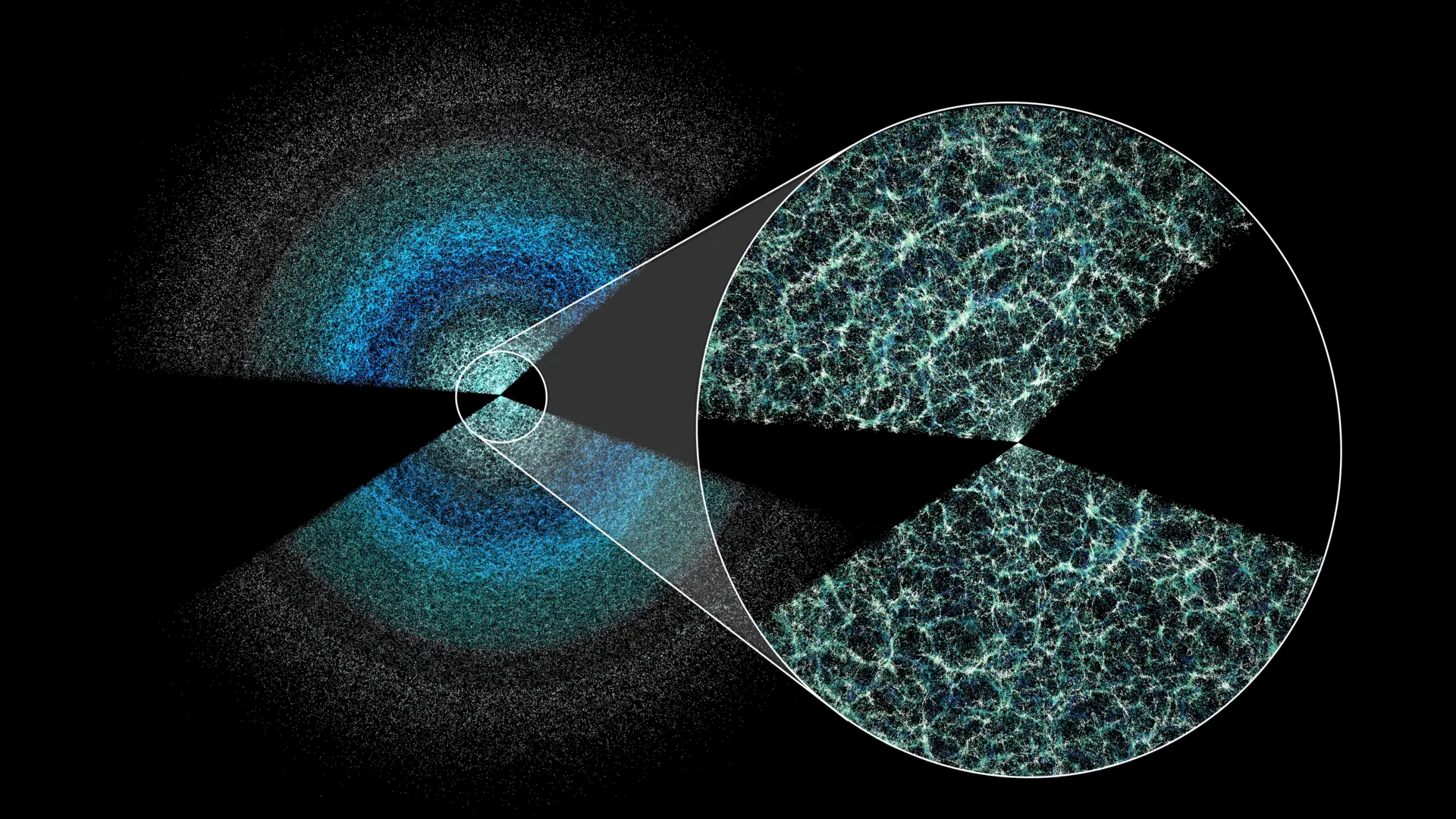
HETDEX, operated by the University of Texas at Austin at the McDonald Observatory, was originally designed as a dark energy survey, using the spectral positions of Lyman-alpha emitting galaxies as tracers of the large-scale structure of the universe. But its wide-field spectroscopic capability — capturing spectra from tens of thousands of objects simultaneously across a large area of sky — made it uniquely suited to detecting the extended, low-surface-brightness halos that surround individual galaxies, which require large statistical samples to characterize reliably. The 33,000-halo catalog is approximately 100 times larger than any previous halo survey.
Analysis of the catalog revealed that halos are ubiquitous, surrounding essentially all detected Lyman-alpha emitters above a certain luminosity threshold, with halo sizes and brightness profiles that depend on the properties of the central galaxy. More massive galaxies tended to have larger, brighter halos, as predicted by models in which larger galaxies have deeper gravitational potential wells capable of retaining more of the gas expelled by stellar feedback. The discovery of clear correlations between halo properties and galaxy properties will allow researchers to test detailed theoretical models of the baryon cycle — the movement of ordinary matter through galaxies — in ways that were not previously possible.
The results are expected to provide constraints on models of galaxy formation that have long struggled to reproduce the observed distribution of galaxy sizes and star formation rates at cosmic noon. Researchers said the catalog would be publicly released in conjunction with the scientific publication and would be available for analysis by the broader astronomical community.