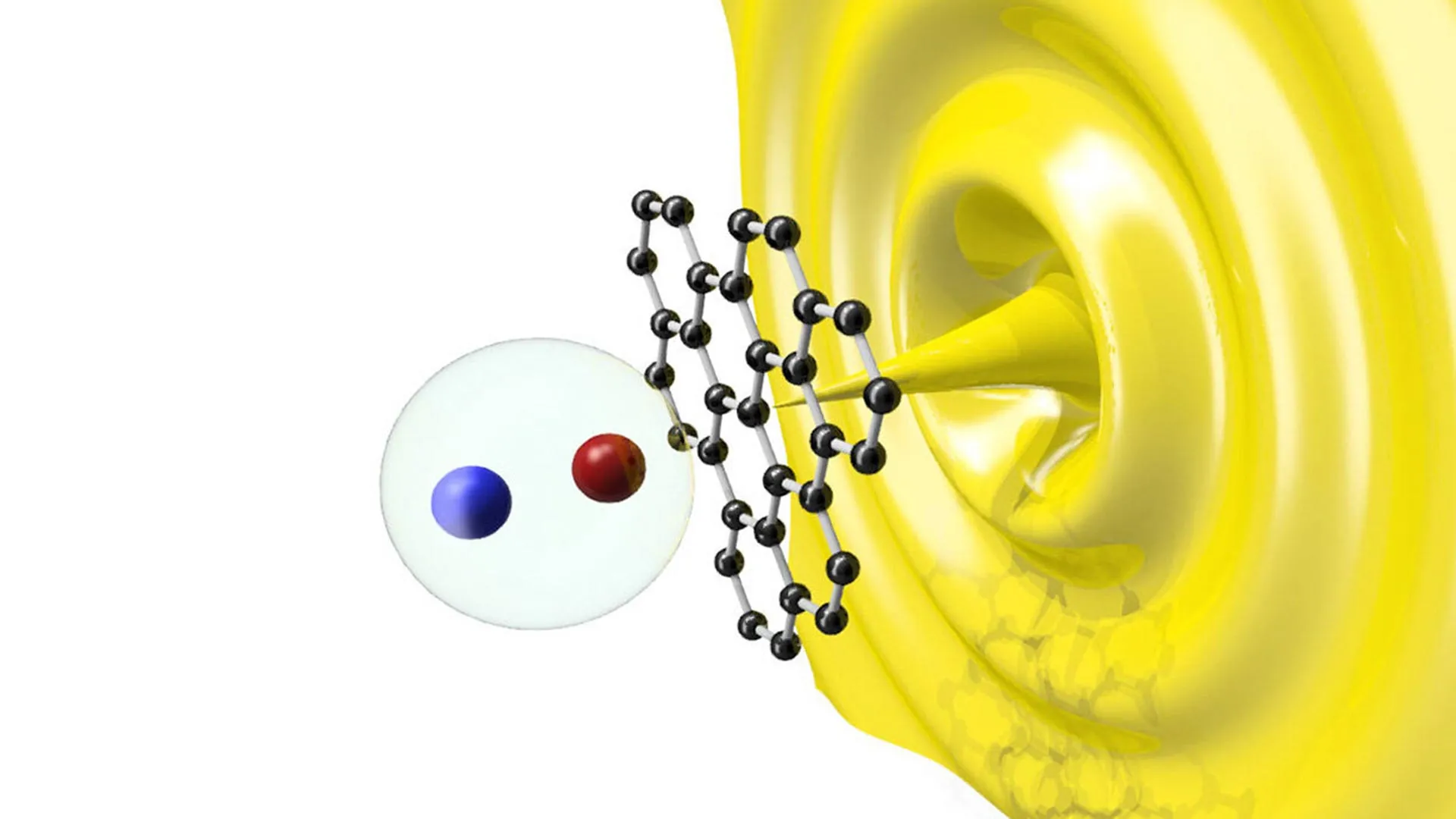
Physicists Crack a 40-Year Quantum Standoff — Resolving Two Incompatible Models of How Particles Behave
A team at Heidelberg University unified the Fermi polaron model and Anderson's orthogonality catastrophe by showing that even infinitesimal quantum recoil fundamentally changes how impurity particles interact with quantum environments.

Physicists at Heidelberg University have resolved a theoretical standoff that has divided quantum physics for more than four decades, producing a unified framework that reconciles two previously incompatible models of how quantum particles interact with their surroundings. The work, published in Physical Review Letters on February 8, 2026, by doctoral candidate Eugen Dizer and Prof. Richard Schmidt of Heidelberg's Institute for Theoretical Physics, has been described by reviewers as closing one of the longest-running open arguments in the field of many-body quantum physics.
The conflict centered on what physicists call the quantum impurity problem: what happens, at the quantum mechanical level, when a single foreign particle — an "impurity" — is introduced into a quantum environment made up of many other particles? This seemingly simple question turns out to be extraordinarily difficult to answer, because the impurity and the surrounding particles interact in subtle, correlated ways that cannot be described by simply adding up independent effects. Two competing theoretical frameworks developed over the past half century each captured important aspects of the physics but made predictions that fundamentally contradicted each other in certain regimes.
The first model, associated with the concept of the mobile Fermi polaron, describes the impurity as a particle that moves through its environment and acquires an effective mass due to the distortion it creates — like a ball moving through a dense liquid, which drags some of the liquid along with it. This model predicts that a quasiparticle — a stable, well-defined composite object — should form even when the impurity is very heavy. The second model, rooted in Philip Anderson's 1967 orthogonality catastrophe, predicts the opposite: that a heavy impurity causes such a profound disruption in the surrounding quantum environment that no stable quasiparticle can form at all. The environment is so strongly disturbed that the ground state before and after the impurity arrives are, mathematically, completely orthogonal — meaning the two scenarios share essentially no quantum mechanical overlap.
Dizer and Schmidt's breakthrough came from recognizing that both models had been making an idealized assumption: that heavy impurities are perfectly stationary. Once the team allowed even the tiniest amount of motion — a quantum recoil too small to matter classically, but significant at the quantum level — the entire picture changed. The recoil provides a small but critical energy gap that enables the formation of a quasiparticle, even in regimes where Anderson's catastrophe would otherwise predict none. "The key insight is that even an infinitesimally small mass ratio changes the problem qualitatively," Schmidt explained. "The two models were not actually describing the same physical situation. Once you account for recoil correctly, they can be unified."
The resolution has immediate implications for a wide range of physical systems that are described by quantum impurity models, including ultracold atomic gases (which can be precisely controlled in laboratory traps), electrons in certain metals and semiconductors, and quasiparticles in recently discovered two-dimensional quantum materials. Experimentalists working with lithium-potassium atomic mixtures in quantum gas microscopes — systems that have been at the center of the Fermi polaron debate — quickly noted that the Heidelberg framework makes specific, testable predictions that differ from both earlier models. Those experiments are expected to be run in the coming months at several European and American laboratories. Beyond the immediate physics, the unified framework provides a new theoretical tool that could be applied to other long-standing quantum impurity problems in materials science and chemistry.