Hegseth, Caine Defend $1.5 Trillion Pentagon Budget and Iran War in First House Testimony Since Bombing Began
The Defense Secretary asked lawmakers to fund a 50% spending hike — the largest single-year increase in a generation. Democrats demanded an exit strategy. The 60-day War Powers clock runs out Friday.
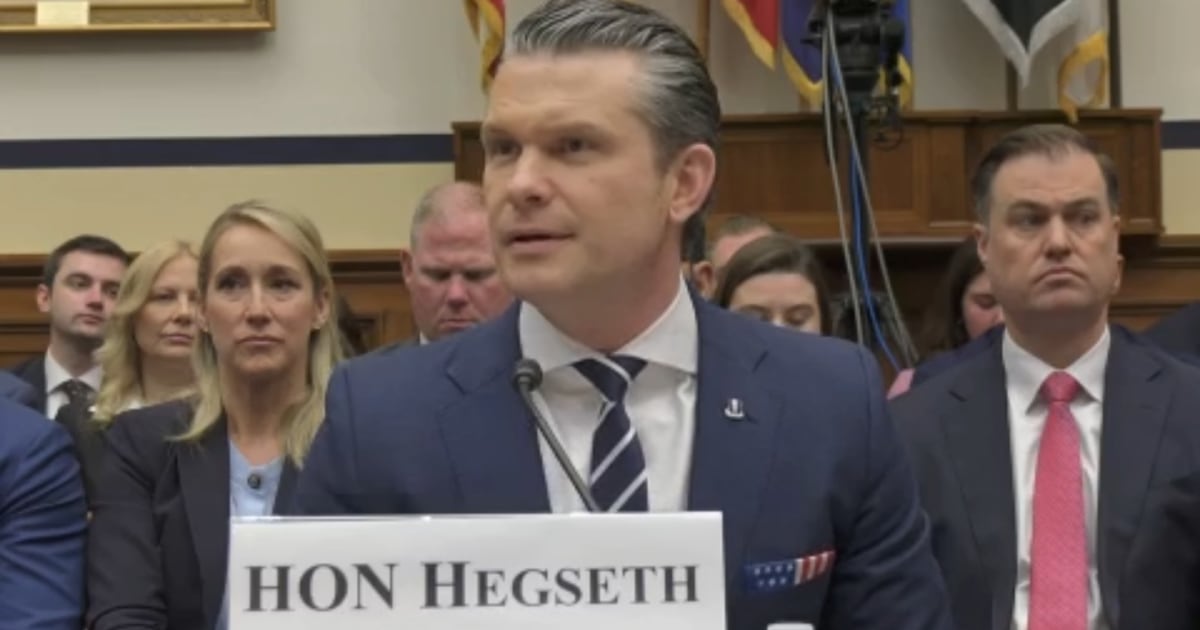
Defense Secretary Pete Hegseth and Joint Chiefs Chair Gen. Dan Caine spent more than five hours before the House Armed Services Committee on Wednesday, defending President Trump's record-setting $1.5 trillion fiscal year 2027 Pentagon budget and answering pointed questions about the Iran war in the first public House testimony either has given since American B-2 bombers struck Iranian nuclear facilities in March.
The hearing landed two days before a 60-day War Powers Resolution deadline that, absent congressional authorization, requires the president to wind down hostilities by Friday. Democrats made clear they intend to force a vote. "You came here today to ask for the largest single-year defense increase in a generation," ranking member Adam Smith of Washington told Hegseth in his opening statement. "What the country deserves first is an honest accounting of the war you are running, what victory looks like, and when our service members come home."
The administration's request would push Pentagon spending from roughly $1 trillion to $1.5 trillion, a 50 percent jump that Hegseth told the committee was needed to "deter China, defeat the regime in Tehran, and rebuild a hollow force." The proposal triples drone procurement to $74 billion, raises munitions spending to more than $30 billion, and funds a 4.5 percent troop pay raise. It also includes the first new aircraft carrier authorization in eight years and accelerates the Sentinel intercontinental ballistic missile program despite a recent Government Accountability Office report flagging $50 billion in cost overruns.
Caine, taking questions from both parties, was more forthcoming about operational details than Hegseth. He told the panel that 11 U.S. service members have died in the Iran campaign — eight in combat, three in non-combat incidents — and that an additional 64 have been wounded. He confirmed for the first time that Iranian retaliatory strikes have hit Al Udeid Air Base in Qatar, Erbil in Iraq, and a logistics hub in Jordan, though he said no further American casualties resulted from the latter two. The Pentagon's running cost for the war, Caine said, has now exceeded $42 billion, with monthly burn approaching $7 billion.
Hegseth repeatedly refused to articulate a specific exit strategy, telling Rep. Mikie Sherrill, D-N.J., that "the strategy is to win, and victory is when Iran can no longer threaten the United States or its partners with a nuclear weapon." Pressed by Rep. Pat Ryan, D-N.Y., a West Point graduate and former Army officer, Hegseth declined to commit to seeking congressional authorization if the president decides to extend operations past the 60-day window, saying the administration's lawyers had concluded existing authorities are sufficient. That answer drew an audible groan from several committee Democrats.
Republicans largely defended the budget request and the war effort, though several pressed Hegseth on the recent firings of Navy Secretary John Phelan and Army Chief of Staff Gen. Randy George — both removed last month under circumstances the Pentagon has not publicly explained. Rep. Don Bacon, R-Neb., a retired Air Force brigadier general, told Hegseth that "the speed and frequency of senior officer dismissals is starting to look like instability," and warned that "you can't run a war this way." Hegseth said only that the moves were made "in the best interest of the force" and that he would not discuss personnel decisions in open session.
Speaker Mike Johnson said after the hearing that the House will vote next week on a Republican-drafted authorization for the use of military force against Iran, a measure that would supersede the 60-day clock if it passes the Senate. A bipartisan war powers resolution forcing withdrawal, sponsored by Reps. Thomas Massie, R-Ky., and Ro Khanna, D-Calif., is also on the calendar. Both votes are expected to be close.