Record-Clear Black Hole Collision Signal GW250114 Confirms Einstein's Relativity and Hawking's Area Theorem
A landmark paper in Physical Review Letters shows the clearest gravitational wave ever recorded yielded the first detection of an exotic black hole 'overtone' and the strongest experimental proof yet of Hawking's 1971 area theorem.
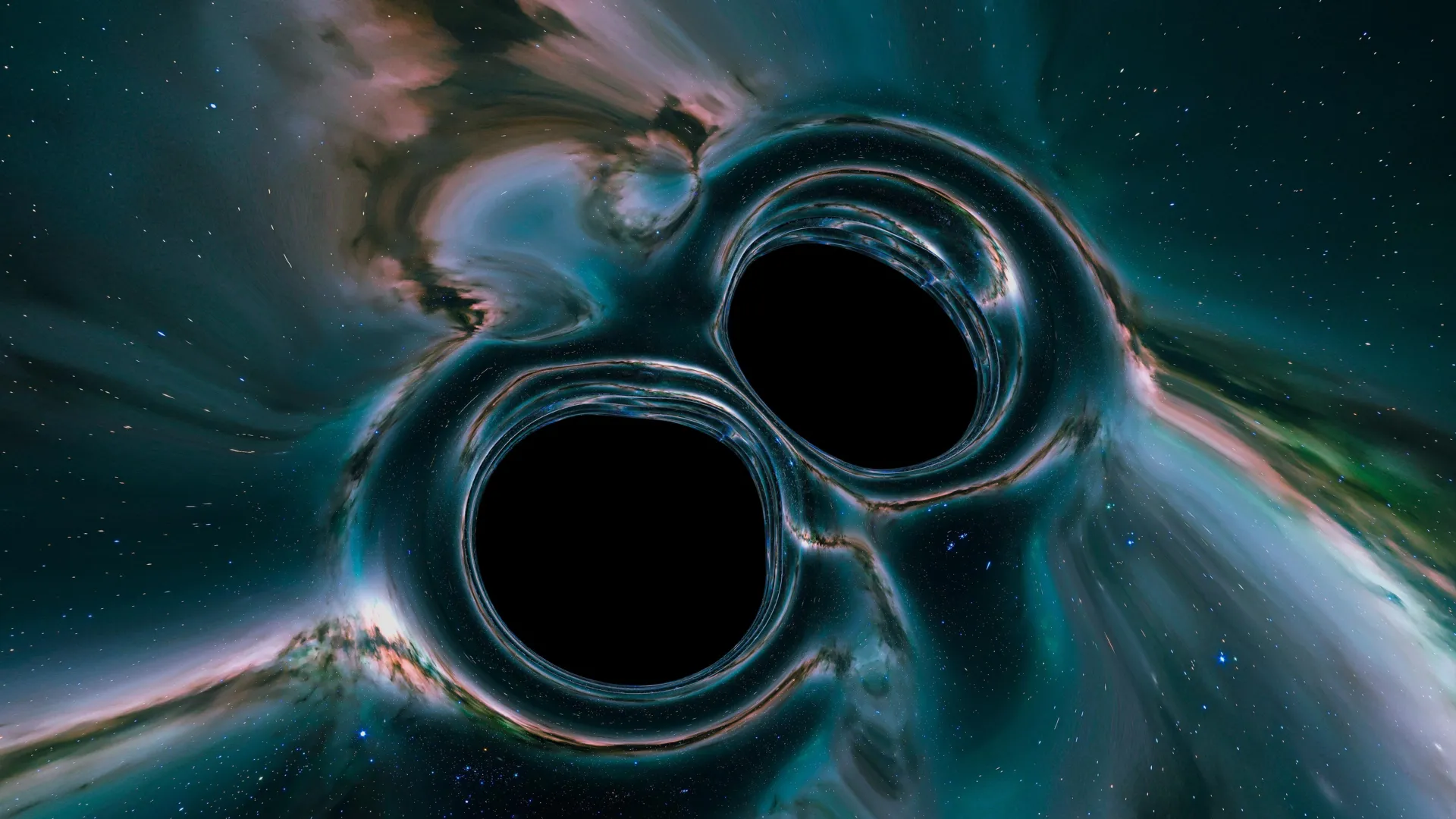
Scientists have published the most detailed analysis yet of GW250114, the clearest gravitational wave signal ever recorded from merging black holes — and the findings deliver powerful confirmation of both Albert Einstein's general theory of relativity and a 55-year-old theoretical prediction by Stephen Hawking about the fundamental behavior of black holes.
The study, published January 29 in Physical Review Letters by the LIGO Scientific Collaboration, the Virgo Collaboration, and the KAGRA Collaboration, analyzed the gravitational wave event GW250114, which was detected by the Laser Interferometer Gravitational-Wave Observatory on January 14, 2025, and publicly announced in September 2025. The signal had a signal-to-noise ratio of approximately 77 to 80 — nearly twice that of GW230814, the previous record-holder — making it an unprecedented tool for testing the physics of spacetime under extreme conditions.
The event involved two black holes approximately 1.3 billion light-years from Earth spiraling inward and merging: one with a mass about 33.6 times that of the Sun, the other about 32.2 solar masses. The combined remnant weighed in at roughly 62.7 solar masses, with the missing mass radiated away as gravitational waves at the moment of collision. What made GW250114 exceptional was not the masses involved — which closely resembled those in the landmark 2015 detection GW150914, the first-ever gravitational wave observed — but the extraordinary clarity of the signal, which allowed researchers to resolve structures in the data never before detectable.
For the first time, researchers were able to identify two distinct "tones" in the post-merger gravitational wave signal: the fundamental oscillation and the first overtone of the Kerr solution — the mathematical description of a rotating, or spinning, black hole. The detection of this overtone at 4.1 sigma significance represents the first time scientists have confirmed this exotic feature in a real-world black hole merger. "The event is pretty much identical to the first one we observed 10 years ago," said Cornell physicist Keefe Mitman, "but much clearer." The dual-tone detection allowed for multiple independent verification tests of Einstein's equations in the strong-field, high-curvature regime where any departures from general relativity would be most visible.
The paper also provides the most direct experimental confirmation to date of Hawking's area theorem, first proposed by Stephen Hawking in 1971. The theorem states that the total surface area of black holes in an isolated system cannot decrease over time — a result with deep parallels to the second law of thermodynamics and its implication that certain physical processes are irreversible. Previous gravitational wave detections had hinted at the area theorem's validity, but the sharpness of GW250114's signal allowed the research team to confirm it with far greater statistical confidence than had previously been possible. All other measured properties of the merger matched Einstein's general relativity predictions with remarkable precision.
Despite the confirmation of existing theory, scientists are quick to note what the result cannot tell us. The LIGO-Virgo-KAGRA detectors are currently operating in their fourth observing run, with a growing catalogue of black hole mergers accumulating month by month. Physicists hope that eventually, a signal will deviate — however slightly — from general relativity's predictions, potentially revealing new physics concerning quantum gravity, dark matter, or other unresolved mysteries of the universe. The global collaboration behind the detection spans hundreds of institutions across the United States, Europe, and Japan, and continues to push the sensitivity of gravitational wave astronomy toward ever more distant and exotic events.
Originally reported by Physical Review Letters / ScienceDaily.