Mathematician Who Proved Chaos Has Hidden Order Wins $3 Million Breakthrough Prize
Frank Merle's decades of work on nonlinear evolution equations — showing how chaotic waves eventually decompose into stable forms — earned him the 2026 Breakthrough Prize in Mathematics.
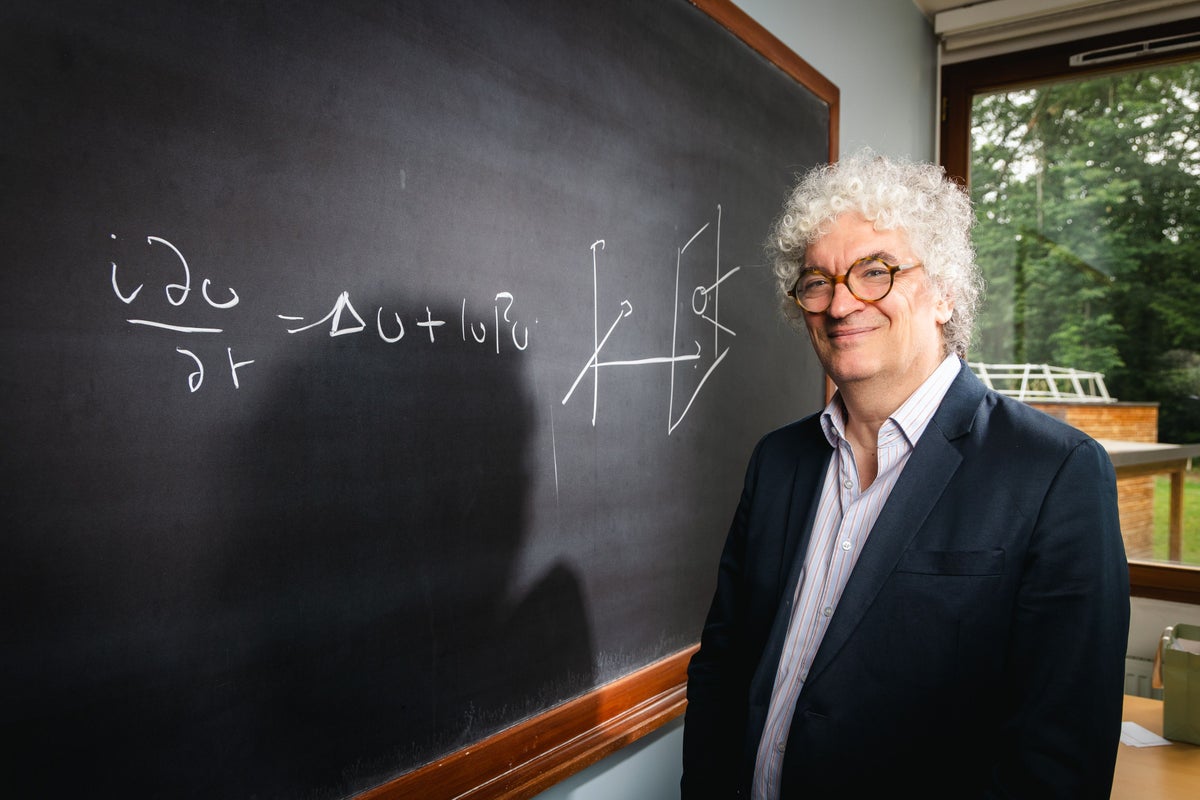
The 2026 Breakthrough Prize in Mathematics — a $3 million award considered the richest prize in mathematics — was presented Saturday night to Frank Merle of CY Cergy Paris Université and the Institut des Hautes Études Scientifiques in France, for a career of breakthroughs in understanding nonlinear evolution equations: the mathematical language that describes how waves, fluids, and quantum particles change over time in ways that resist simple, tidy description.
Merle, who received the prize at a ceremony at Barker Hangar in Santa Monica, California, has spent decades developing tools to study mathematical chaos directly rather than treating turbulent behavior as a slight departure from idealized, linear systems. The Breakthrough Prize Foundation cited his work for "breakthroughs in nonlinear evolution equations, with regards to their stability, singularity formation, or resolution into solitons." He described his worldview with characteristic candor: "I see the world as a more catastrophic place to live." It is precisely that orientation — a willingness to engage with the violent, unpredictable behavior of equations rather than looking away from it — that made his career so generative.
The technical core of Merle's most celebrated achievement is his work, with collaborators Carlos Kenig and Thomas Duyckaerts, developing the "channels of energy technique" and related tools in support of the soliton resolution conjecture. The conjecture holds that any sufficiently complex nonlinear wave disturbance — no matter how chaotic it appears — will eventually decompose into a set of stable, shape-preserving waves called solitons, each moving at its own speed, plus a remainder that dissipates. Solitons are the quantum mechanical equivalent of persistent, self-organizing structures in an otherwise turbulent medium; they appear in fiber optic cables, shallow water waves, and quantum field theories. Merle's contributions brought the mathematical community significantly closer to proving that what looks like disorder has hidden order underneath. He described the insight as revealing "a simplicity that's very hidden, very difficult to see."
His work also yielded some of the most counterintuitive results in modern analysis. Working with Pierre Raphael, Igor Rodnianski, and Jérémie Szeftel, Merle proved that the defocusing nonlinear Schrödinger equation — long believed to be inherently stable — can in fact develop singularities in finite time. This result stunned the mathematical community: the defocusing version of the Schrödinger equation was thought to represent a system that naturally disperses energy and avoids blow-up behavior. Merle showed that under the right initial conditions, this intuition is wrong. He produced similarly surprising results for laser equations, proving that extreme energy concentration — blow-up — can occur in physical laser focusing scenarios, and for compressible fluid equations, proving that friction alone cannot prevent singularities from forming.
The prize was announced at the same ceremony that honored the Muon g-2 collaboration in physics and three teams in the life sciences. Total prize money distributed at the 2026 Breakthrough Prize ceremony exceeded $18.75 million, including New Horizons awards for early-career researchers. Merle expressed surprise at the recognition, noting that his methods initially attracted scepticism in the mathematical community. "When I started working on these problems this way, not everyone believed it was the right approach," he said. "What I find gratifying is that over time, a succession of important problems have yielded to these tools, and more and more people have come to see that engaging with the catastrophic is how you understand the structure of the world."