Eight Killed as Air Force B-52 Crashes Seconds After Takeoff at Edwards
The bomber went down on a radar-modernization test flight in the Mojave Desert — the deadliest B-52 accident since 1982 — killing four airmen, two Boeing employees and two government engineers.
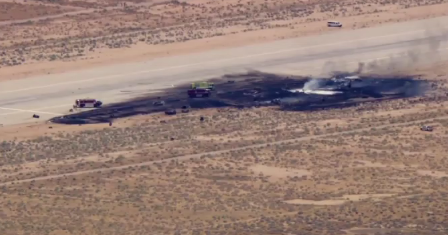
Eight people were killed when a United States Air Force B-52 Stratofortress crashed and burst into flames shortly after takeoff at Edwards Air Force Base in California's Mojave Desert, the base confirmed. The bomber went down at about 11:20 a.m. Monday at the remote airfield, roughly 100 miles northeast of Los Angeles, during what officials described as a routine test mission.
The crew was a mix of military personnel, government civilians and contractors supporting a test flight for a radar modernization program — a reflection of the experimental work that defines Edwards, the Air Force's premier flight-test installation. The crash was later determined to be "not survivable," and the Air Force's Accident Investigation Board has opened a review that officials cautioned could take up to six months to reach initial conclusions.
"The investigation could take an estimated six months," said Colonel James Hayes, deputy commander of the 412th Test Wing, as the base worked through the painstaking process of recovering remains and securing the wreckage. The aircraft, a Cold War-era heavy bomber that the Air Force plans to keep flying into the 2050s, was being used to test upgraded systems intended to extend its service life.
The base released the names of the eight people killed. They included weapons systems officers Lt. Col. Gabriel Estrella, 40, and Maj. Alexander Davis, 34; 419th Flight Test Squadron pilots Maj. Robert Dee, 40, and Maj. Brad Hovey, 35; flight test engineer Jeremy Smith, 32; contractor and flight test engineer Christopher Rischar, 41; retired Lt. Col. Miles Middleton, 50, a Boeing pilot; and Col. Gregory Watson, 53, a Boeing weapons officer and Air Force reservist assigned to Naval Air Station Joint Reserve Base Fort Worth, Texas. Boeing confirmed that two of its employees were among the dead.
The disaster is the deadliest B-52 crash since 1982, when a Stratofortress went down at Mather Air Force Base near Sacramento, killing all nine crew members aboard. It is also the first crash of a B-52 since 2016, when one was destroyed at Andersen Air Force Base in Guam, injuring seven. The Air Force operates a fleet of roughly 70 of the bombers, a backbone of the U.S. strategic arsenal for more than six decades.
Flags at Edwards were lowered as the installation, accustomed to the inherent risks of test flying, absorbed one of its worst single-day losses in years. Test crews at the base routinely push aircraft and new systems to their limits, work that carries danger even on flights billed as routine. Air Force leaders pledged a thorough accounting, and grief counselors were made available to the tight-knit community of airmen, engineers and contractors who keep the aging bomber fleet flying.
Originally reported by CBS News.