NASA-Led Study Solves Climate Paradox: Why the Same CO2 Warms the Surface But Cools the Upper Atmosphere by 2°C
A new Nature Geoscience paper combines 22 years of TIMED and SABER satellite data with refined radiative-transfer models to show how the upper atmosphere has shrunk visibly as carbon dioxide climbs.
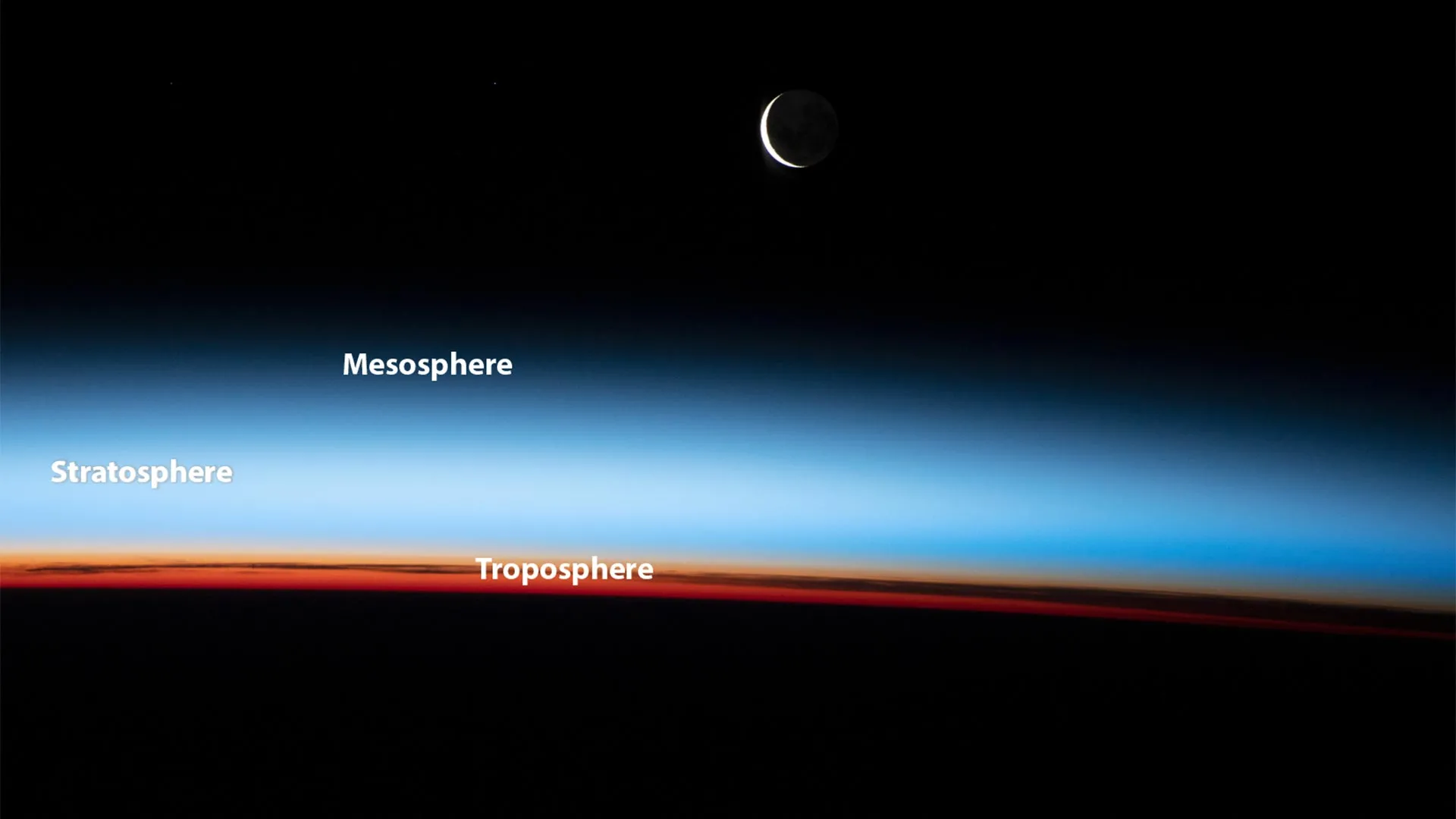
Climate scientists have spent four decades watching the same molecule — carbon dioxide — heat the bottom mile of Earth's atmosphere while simultaneously chilling the layers above. The stratosphere has cooled by roughly 2 degrees Celsius since the mid-1980s, more than ten times what would be expected without human emissions, and the mesosphere above it has cooled even more sharply, contracting visibly enough that orbiting satellites need less frequent reboosts to maintain altitude. A new study published this month in the journal Nature Geoscience and summarized by ScienceDaily on May 13 finally lays out, layer by layer, how the same gas can warm one part of the atmosphere and cool another.
The answer turns on a physical phenomenon known as radiative cooling. In the lower troposphere, where Earth's surface is densely blanketed by air, water vapor and CO2 molecules absorb infrared radiation rising from the ground and re-emit it in all directions, including back down. That's the greenhouse effect, and it's why the planet's surface is a livable 15 degrees Celsius rather than the minus-18 it would be in a CO2-free atmosphere. The team, led by climate physicist Martin Mlynczak of NASA Langley and atmospheric chemist John Gille at the University of Colorado Boulder, used a combination of satellite spectrometry and high-resolution atmospheric models to show that the same CO2 molecules play the opposite role in the thinner air above.
Above roughly 30 kilometers, the atmosphere is sparse enough that an infrared photon emitted by an excited CO2 molecule has a high probability of escaping to space rather than being reabsorbed nearby. The researchers identified a "Goldilocks zone" of infrared wavelengths near 15 micrometers where CO2 emits efficiently and the surrounding gas is essentially transparent. Adding more CO2 in this regime gives the upper atmosphere a more powerful radiator, and the net effect is to bleed thermal energy directly into space. The team's model reproduces the observed 2-degree stratospheric cooling almost exactly when historical CO2 increases are dialed in.
The cooling is not a footnote. As the mesosphere chills, it physically shrinks, dropping the density at any given altitude. That has measurable consequences for satellite drag — the International Space Station and the Starlink constellation both experience less of it as the upper atmosphere contracts — and it can subtly shift the ionosphere, affecting GPS and shortwave radio propagation. "You can think of CO2 as a smart blanket," Mlynczak said in a NASA statement. "It traps heat near the surface, but it acts like an open window in the upper atmosphere, letting heat radiate straight to space."
The finding closes a longstanding gap between observational data and theory. Earlier models had broadly predicted stratospheric cooling, but they undershot the magnitude and could not cleanly account for the mesospheric contraction. The new paper combines 22 years of satellite measurements from the TIMED and SABER missions with a refined treatment of the non-equilibrium thermodynamics that govern thin-air radiative transfer. Climate modelers say the work will sharpen projections of how much the upper atmosphere will shrink as CO2 climbs toward 500 parts per million, a level expected before 2050 under current emissions trajectories — and it underscores the breadth of human influence on the planet, all the way to the edge of space.