Chinese Scientists Confirm 87-Year-Old Quantum Prediction, Opening New Path to Dark Matter Detection
A team from the University of Chinese Academy of Sciences achieved five-sigma confirmation of the Migdal effect, published in Nature, enabling detectors to hunt for far lighter dark matter particles.
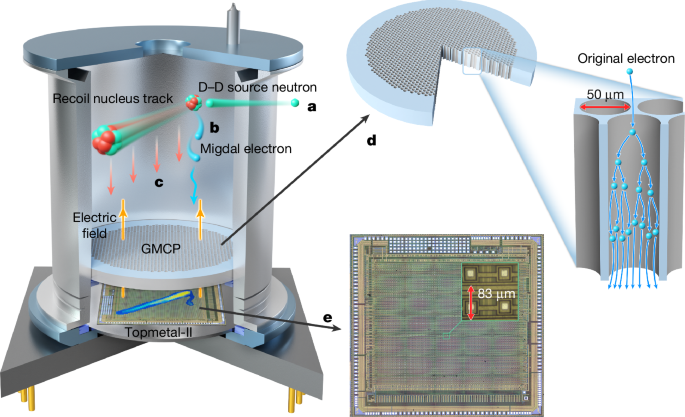
Chinese physicists have achieved the first direct experimental observation of the Migdal effect, confirming a quantum mechanical prediction that sat unproven for 87 years and opening a powerful new avenue for detecting dark matter. The research, published January 19, 2026, in the journal Nature, was led by a team from the University of Chinese Academy of Sciences working with specialized gas detectors built around custom microchips. Out of more than 800,000 candidate events analyzed, the team identified six unmistakable signals — each displaying the defining signature the Soviet physicist Arkady Migdal described in 1939: two particle tracks emerging from exactly the same point, one from a recoiling atomic nucleus and one from an electron ejected in the process.
The Migdal effect describes what happens when a neutral particle — a neutron, or potentially a dark matter candidate — collides with an atomic nucleus. The nucleus recoils suddenly, and the rapid shift in the atom's internal electric field can strip away one of the atom's orbiting electrons. Migdal predicted this in a theoretical paper published just before the Second World War, but no experiment had ever captured it directly until now. The statistical confidence of the Chinese team's detection reached the five-sigma threshold — the gold standard in particle physics — meaning the probability that the signal arose by chance is less than one in 3.5 million.
"With the Migdal effect, once an electron is ejected, our detector can, in theory, capture 100% of its energy," explained a researcher from the UCAS team. That seemingly technical distinction has enormous practical implications for dark matter hunting. Today's leading detectors are designed to catch the recoil of atomic nuclei when dark matter particles pass through them. But nuclei are heavy, and very light dark matter particles — those with masses below the proton scale — don't transfer enough energy to a nucleus to produce a detectable signal. The ejected electron in the Migdal process is far lighter and moves much faster, amplifying what would otherwise be an undetectable nudge into a signal instruments can actually see.
The finding therefore opens the search for dark matter to a previously inaccessible mass range. Current experiments, including LUX-ZEPLIN in South Dakota and the XENONnT detector in Italy, are sensitive primarily to dark matter particles heavier than roughly 1 gigaelectronvolt. If dark matter instead consists of much lighter particles — a possibility that many theorists consider attractive — those experiments would be blind to it. The Migdal effect provides a mechanism to extend sensitivity to particles far below that threshold, potentially by several orders of magnitude.
The research team used neutrons to simulate the expected behavior of dark matter particles, as neutrons interact with nuclei through the same kind of contact forces that light dark matter candidates would. The detector's ability to resolve both the nuclear recoil track and the electron track simultaneously, in a three-dimensional gas chamber, was key to achieving the unambiguous identification of Migdal events. Future detectors designed specifically to exploit the effect could scan a vast new slice of parameter space where dark matter might be hiding, giving experimentalists fresh tools to crack one of the deepest mysteries in modern physics — what accounts for roughly 85% of all the matter in the universe.