Chinese Physicists Confirm 87-Year-Old Quantum Prediction, Opening New Window to Detect Dark Matter
The first direct observation of the Migdal effect — six confirmed particle events out of 800,000 candidates — achieves the five-sigma gold standard and could unlock detection of light dark matter particles invisible to every current experiment.

A team led by the University of Chinese Academy of Sciences has achieved the first direct experimental observation of the Migdal effect — a quantum phenomenon predicted in 1939 by Soviet physicist Arkady Migdal and never confirmed in a laboratory until now. The result, published in the journal Nature and announced in January 2026, has been described by physicists as a genuine breakthrough because it opens an entirely new detection window for light dark matter, one of the most elusive and consequential targets in modern physics.
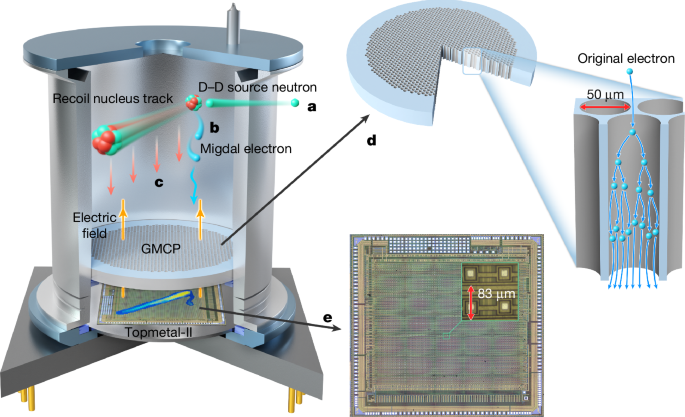
The Migdal effect occurs when an atomic nucleus recoils after being struck by an incoming particle. In classical physics, the orbiting electrons simply rearrange themselves to follow the nucleus. But Migdal predicted that the sudden shift in the atom's electric field during a high-velocity recoil could instead eject one of the electrons, producing a separate, detectable charged particle track alongside the nuclear recoil signal. For 87 years the prediction went untested, because detecting these rare events requires extraordinary sensitivity at the atomic level.
The Chinese team built a high-precision gas pixel detector equipped with custom-designed microchips sensitive enough to track individual atomic interactions. They bombarded gas molecules with neutrons and analyzed more than 800,000 candidate events across extended runs of the experiment. In the data, they identified six clear signals that each showed two distinct particle tracks — one from a recoiling nucleus and one from an ejected electron — emerging from precisely the same interaction point. The result achieved the five-sigma confidence threshold, the gold standard in particle physics for declaring a discovery. "With the Migdal effect," said researcher Zheng Yangheng of UCAS, "the detector can capture 100% of the electron's energy, which was previously invisible to us."
The significance extends far beyond confirming a decades-old prediction. Dark matter is believed to constitute approximately 85% of all matter in the universe, yet no direct detection experiment has ever observed it. Current detectors are designed to find heavy WIMP dark matter by sensing nuclear recoils energetic enough to leave a measurable signature. But lighter dark matter particles would deposit far too little energy in a nuclear recoil to trigger those detectors. The Migdal effect changes the math: by converting a nearly invisible low-energy nuclear recoil into a comparatively bright electron signal, it makes light dark matter detectable in principle. "This is a crucial first step toward applying it in the search for light dark matter," said Liu Jianglai of Shanghai Jiao Tong University.
Physicist Yu Haibo of the University of California, Riverside, who was not involved in the research, called the result "a genuine breakthrough and truly exciting." The finding is expected to trigger a new generation of dark matter detection experiments designed specifically to exploit the Migdal channel. Several groups in Europe, North America, and China are already reported to be proposing scaled-up detectors that would extend the sensitivity to dark matter masses below one gigaelectronvolt — territory that has been essentially closed off to experimental physics until now.