Scientists Find 'Nature's Algorithm' Hidden in the Leaves of the Chinese Money Plant
A study in Nature Communications shows Pilea peperomioides arranges its leaf veins as a Voronoi diagram, the same mathematical pattern engineers use to optimize networks.
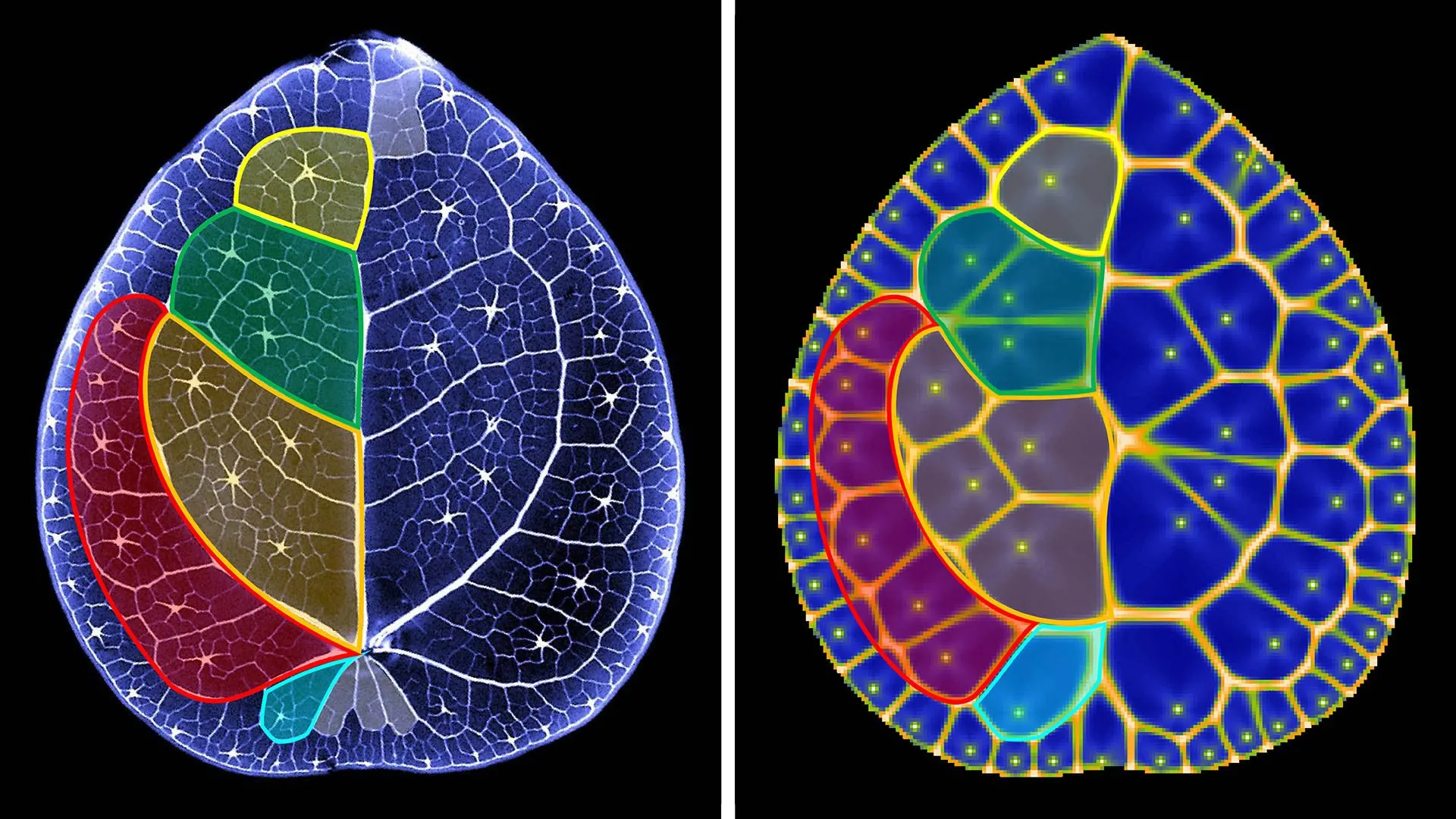
A team of botanists and applied mathematicians has discovered that the circular, coin-shaped leaves of the Chinese money plant, Pilea peperomioides, contain a near-perfect example of a Voronoi diagram — the same mathematical structure that engineers use to lay out cell-phone towers, route emergency vehicles, and design efficient computer networks. The findings, published this week in Nature Communications, suggest that the houseplant has been quietly solving a difficult optimization problem with no measuring tools, no central planner, and no awareness that it is doing so.
A Voronoi diagram divides a plane into regions around a set of seed points, so that every location inside a region is closer to its own seed than to any other. The pattern shows up in everything from giraffe coats to soap-foam bubbles, but it is rare to find one in plant veins, which typically organize themselves as a branching tree rather than a tiled mosaic. Pilea peperomioides is unusual in that each round leaf is pocked with tiny water-secreting pores called hydathodes, which sit at the center of a polygonal cell of looping vein traffic. When the researchers mapped the hydathodes and the surrounding vein network, they found a near-perfect Voronoi partition that holds across leaves of different sizes and ages.
"Plants cannot explicitly measure distance, so they have to solve this purely through local biochemical interactions," lead author Jacques Dumais of Adolfo Ibáñez University told reporters. The team used time-lapse imaging combined with mathematical modeling to show that the veins grow toward each other along chemical gradients secreted by the hydathodes, with each pore effectively "claiming" the territory closest to it. As the leaf expands, the veins reorganize themselves to keep the pattern stable, the same way a Voronoi diagram would update if you moved its seed points.
The discovery matters for more than just plant biology. Researchers in network design, robotics, and city planning have spent decades developing algorithms to compute Voronoi partitions efficiently on real-world maps. Finding a living organism that arrives at the same solution using only local cellular signaling could inspire a new class of "morphogenetic" algorithms — distributed computing strategies that build optimized layouts without any central coordinator. Several of the paper's coauthors say they are already exploring whether similar mechanisms could be used to grow tissue-engineering scaffolds or self-assembling antenna arrays.
The result also reopens a long-standing question about how much computation is baked into the natural world. Charles Darwin once asked how plants "decide" anything; modern developmental biology answers that they don't — they follow simple local rules that produce sophisticated global patterns. The Pilea study is a particularly clean example of that principle in action, the authors argue, because the underlying math — Voronoi tessellation — is one of the most carefully studied in computer science. As coauthor Carolina Frias-Bracaglia put it in a press briefing, "We didn't teach the plant the rule. The plant has always been writing the rule. We just learned how to read it."