China's EAST Fusion Reactor Shatters 37-Year Plasma Density Barrier, Validating New Path to Commercial Fusion
Scientists in Hefei achieved stable plasma at 1.65 times the Greenwald limit — a threshold never before crossed — opening the door to compact high-density reactors.

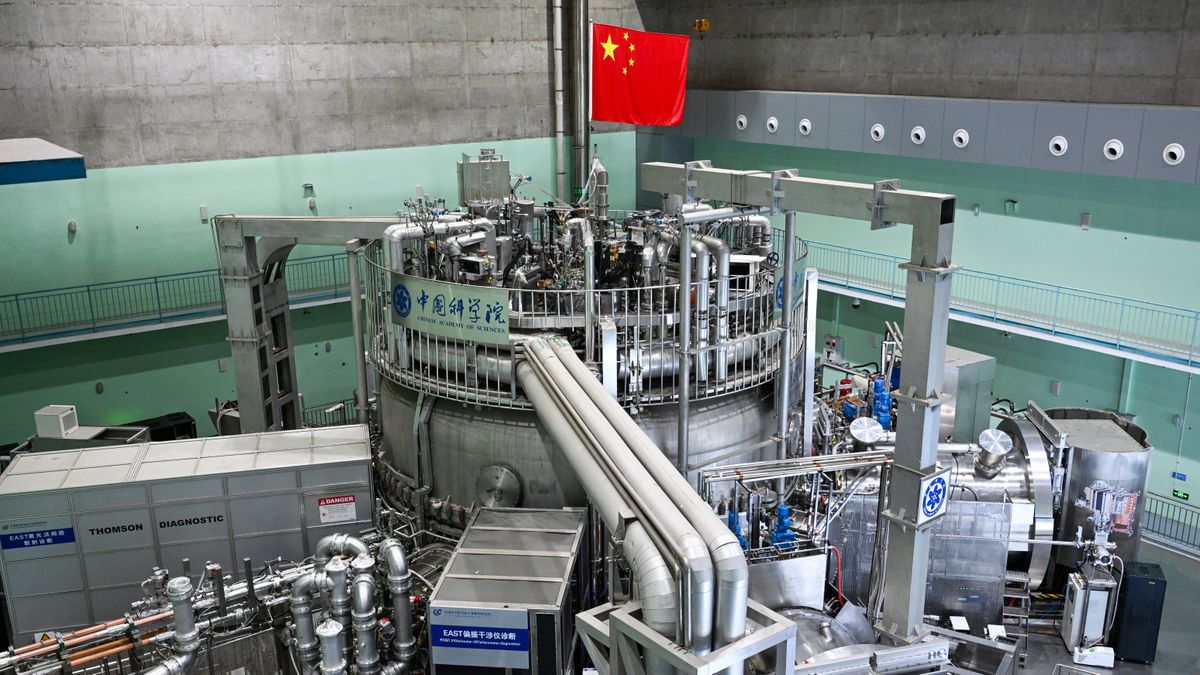
Chinese fusion scientists operating the Experimental Advanced Superconducting Tokamak in Hefei achieved a milestone on January 1, 2026 that had eluded the global fusion community for decades: the first stable plasma operation at densities exceeding the Greenwald limit — a theoretical ceiling on how much fuel a magnetic confinement device can hold before the plasma becomes uncontrollable. The result, published in Nature Physics in February, demonstrates that compact, high-density fusion reactors may be achievable through operating regimes that existing reactor designs were never optimized to exploit.
The Greenwald limit, formulated by MIT physicist Martin Greenwald in 1988, describes an empirical relationship between the density of plasma in a tokamak and the machine's minor radius and current. Virtually every tokamak built in the intervening 37 years has treated this limit as a practical ceiling: push plasma density too far above it and the plasma rapidly becomes turbulent, cools, and terminates the fusion reaction — a phenomenon called a disruption. The EAST experiment achieved electron densities approximately 1.3 to 1.65 times the Greenwald limit while maintaining stable, sustained plasma for several seconds, far longer than any previous attempt to surpass the boundary.
The breakthrough exploited a regime called "super-dense core" operation, in which the plasma profile is carefully shaped using a combination of neutral beam heating, electron cyclotron resonance heating, and real-time feedback control of the magnetic field configuration. By peaking the density strongly in the plasma's center while keeping the edge plasma relatively cool and stable, the EAST team found a window in which the usual disruption mechanisms did not trigger. The key diagnostic was an array of X-ray cameras that provided the research team with millisecond-by-millisecond images of the plasma's internal structure, allowing them to detect and suppress emerging instabilities before they grew catastrophic.
The finding carries significant engineering implications for the international fusion program. Current large-scale fusion projects, including ITER under construction in southern France, are designed around operating below or near the Greenwald limit, which constrains how much fuel — and therefore how much fusion power — a given machine can produce. If the super-dense core regime can be reproduced and optimized, future reactors could potentially achieve higher fusion power output from a smaller, cheaper device. A compact high-density tokamak would also generate less neutron bombardment damage to its structural components per unit of electrical output, reducing the maintenance burden that is one of fusion's primary engineering challenges.
The EAST tokamak, operated by the Institute of Plasma Physics of the Chinese Academy of Sciences, has established itself over the past decade as the world's most productive experimental fusion device in terms of record-setting plasma parameters. In January 2023 it sustained a plasma at 70 million degrees Celsius for 1,056 seconds — nearly 18 minutes. The new density record adds a critical dimension to that achievement: it is not just how long China's fusion program can sustain plasma, but how dense and energetic that plasma can be. The Institute plans to use the new operating regime as the basis for design parameters in the China Fusion Engineering Test Reactor, slated to begin construction in 2027, which is intended to be the first device to produce net fusion energy — meaning more energy out than was put in.