China's 'Artificial Sun' Shatters Fundamental Plasma Barrier, Opening Path to Fusion Power
Scientists at China's EAST tokamak achieved stable plasma at 1.65 times above the Greenwald density limit — a ceiling considered impassable for decades — using a technique that could scale to future commercial fusion reactors.
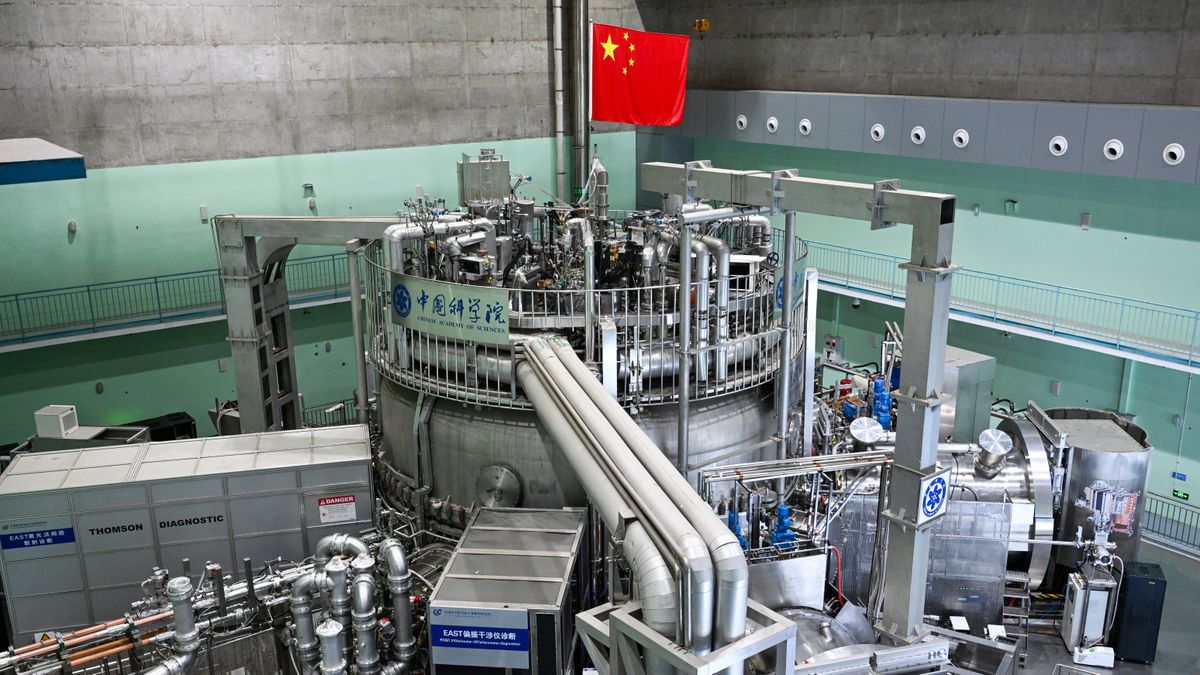
Chinese scientists operating the Experimental Advanced Superconducting Tokamak — known as EAST and nicknamed the "artificial sun" — have broken through one of fusion research's most stubborn barriers, achieving stable plasma at densities 1.3 to 1.65 times above the so-called Greenwald limit, an empirical ceiling that physicists had long considered a hard boundary no tokamak could cross without the plasma collapsing. The results, published in the journal Science Advances on January 1, 2026, by researchers at Huazhong University of Science and Technology and the Hefei Institutes of Physical Science under the Chinese Academy of Sciences, represent a potentially transformative step on the long road toward practical fusion energy.
The Greenwald limit is named after MIT physicist Martin Greenwald, who codified the relationship between plasma density and tokamak disruptions in the 1980s. For decades, it had functioned as a practical ceiling: push plasma too dense, and the accumulated impurities and energy losses cause the superheated gas to become unstable and lose confinement. Because fusion power output scales with the square of plasma density, the limit has been one of the most consequential constraints in the entire field. Exceeding it — stably — is roughly analogous to discovering that an engine can safely run at twice its rated pressure without exploding.
The team's approach, which they call plasma-wall self-organization (PWSO), works by carefully controlling the initial fuel gas pressure and applying electron cyclotron resonance heating at the very beginning of a plasma discharge, before impurities have a chance to accumulate and before instabilities can take hold. By optimizing the plasma-wall interaction from the moment of startup, the researchers found that the plasma could reach and sustain densities well above the Greenwald limit without the usual cascade of energy loss that causes disruptions. "This suggests a practical and scalable pathway for extending density limits in tokamaks and next-generation burning plasma fusion devices," said Prof. Ping Zhu of Huazhong University, one of the lead researchers.
The timing of the announcement is significant. ITER — the massive international fusion reactor under construction in southern France, backed by 35 nations including the United States, China, and the European Union — is designed to achieve its plasma performance targets operating below the Greenwald limit. If the density-free regime demonstrated by EAST can be reliably reproduced and scaled, future machines could potentially operate at higher densities than ITER, generating more fusion power per unit volume and potentially making the economics of commercial fusion electricity more favorable. Several private fusion companies, including Commonwealth Fusion Systems, TAE Technologies, and Helion Energy, have been watching the EAST results closely.
Associate Prof. Ning Yan of the Hefei Institutes, who co-led the experimental work, cautioned that many engineering and scientific challenges remain before the findings can be applied to a commercial reactor. Plasma sustained at above-Greenwald densities has only been demonstrated in EAST's specific configuration, and replicating the results in larger machines — where plasma dynamics differ — will require additional experiments. The EAST reactor itself is also unique in operating at extremely low temperatures in its superconducting coils, enabling it to sustain high magnetic fields for longer pulses than conventional machines. Still, the physics community has received the results with considerable enthusiasm. Nature magazine, which covered the breakthrough in an analysis piece, called it "among the most significant advances in confinement physics in over a decade" and noted that it opens an entirely new parameter space for fusion reactor designers to explore.