CERN Discovers Doubly Charmed Baryon That Eluded Physicists for 24 Years, the LHC's 80th Hadron
The LHCb experiment confirmed the Xi-cc-plus particle — made of two charm quarks and one down quark — at 7-sigma confidence, closing a mystery that began with ambiguous Fermilab hints in 2002.
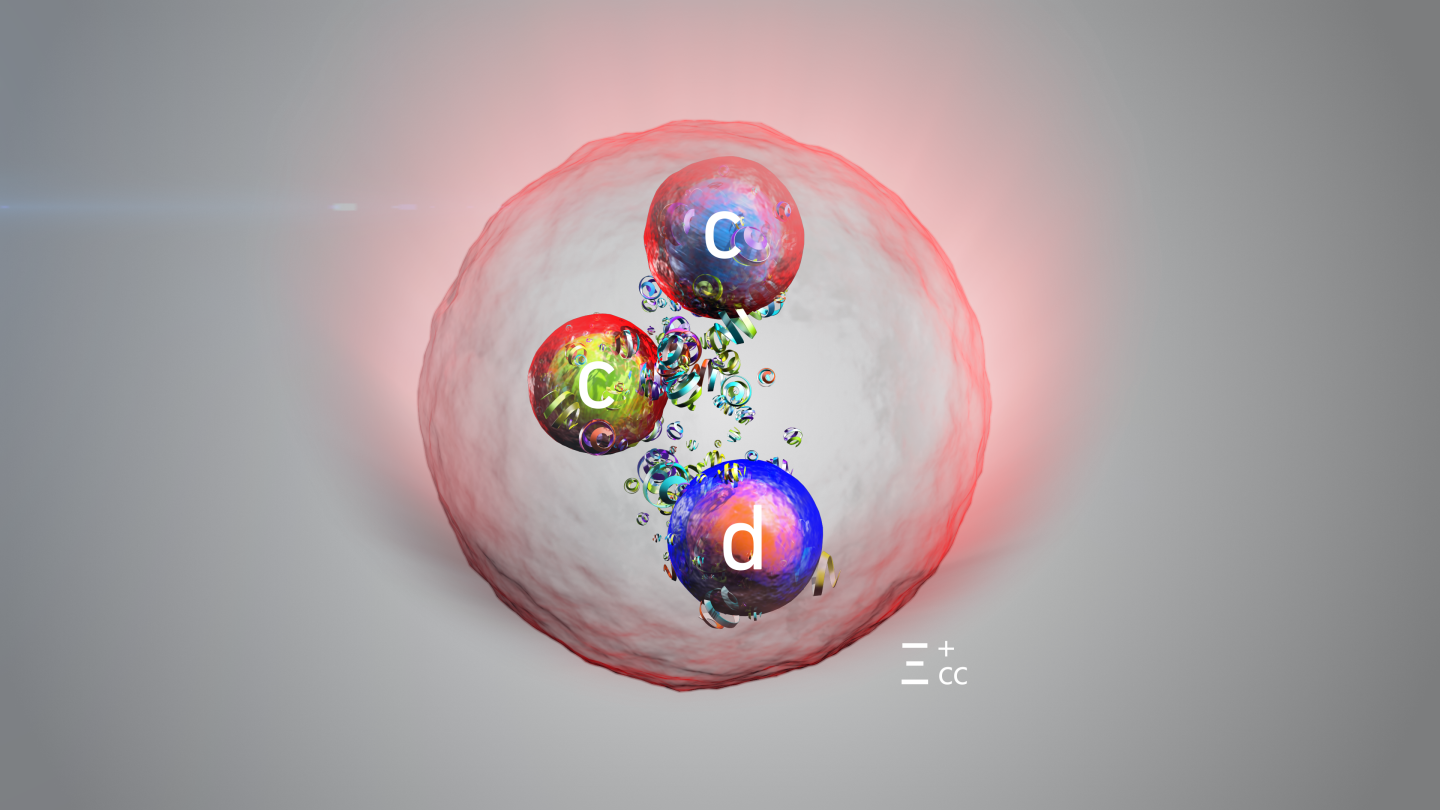
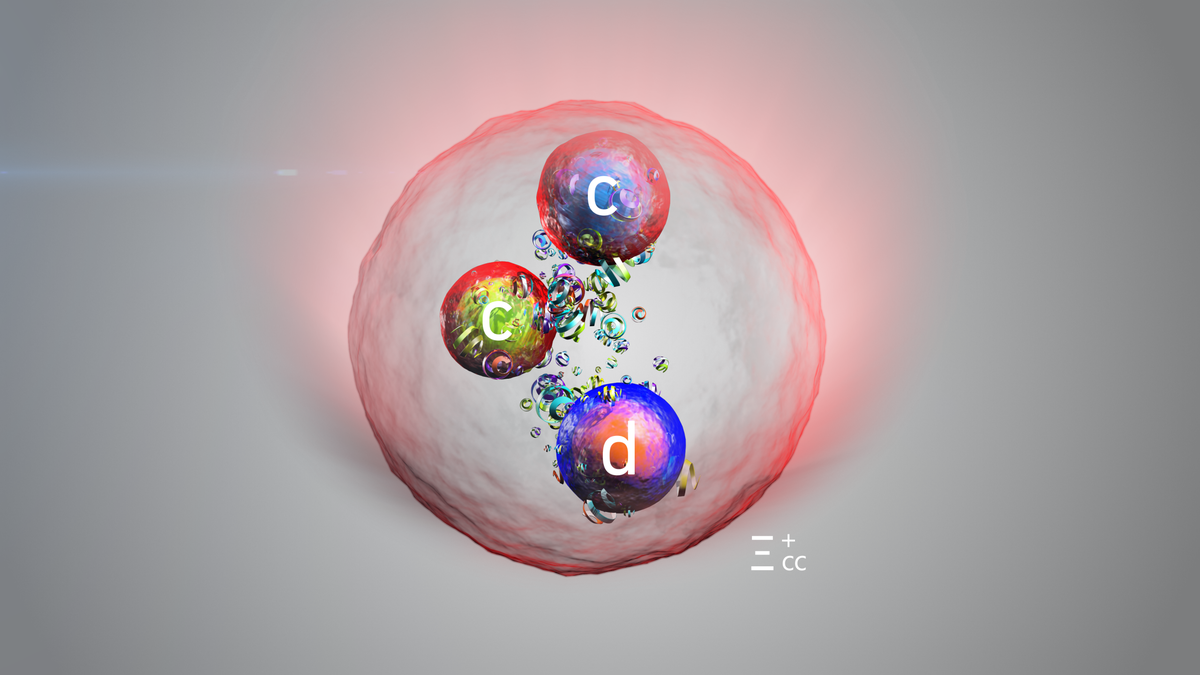
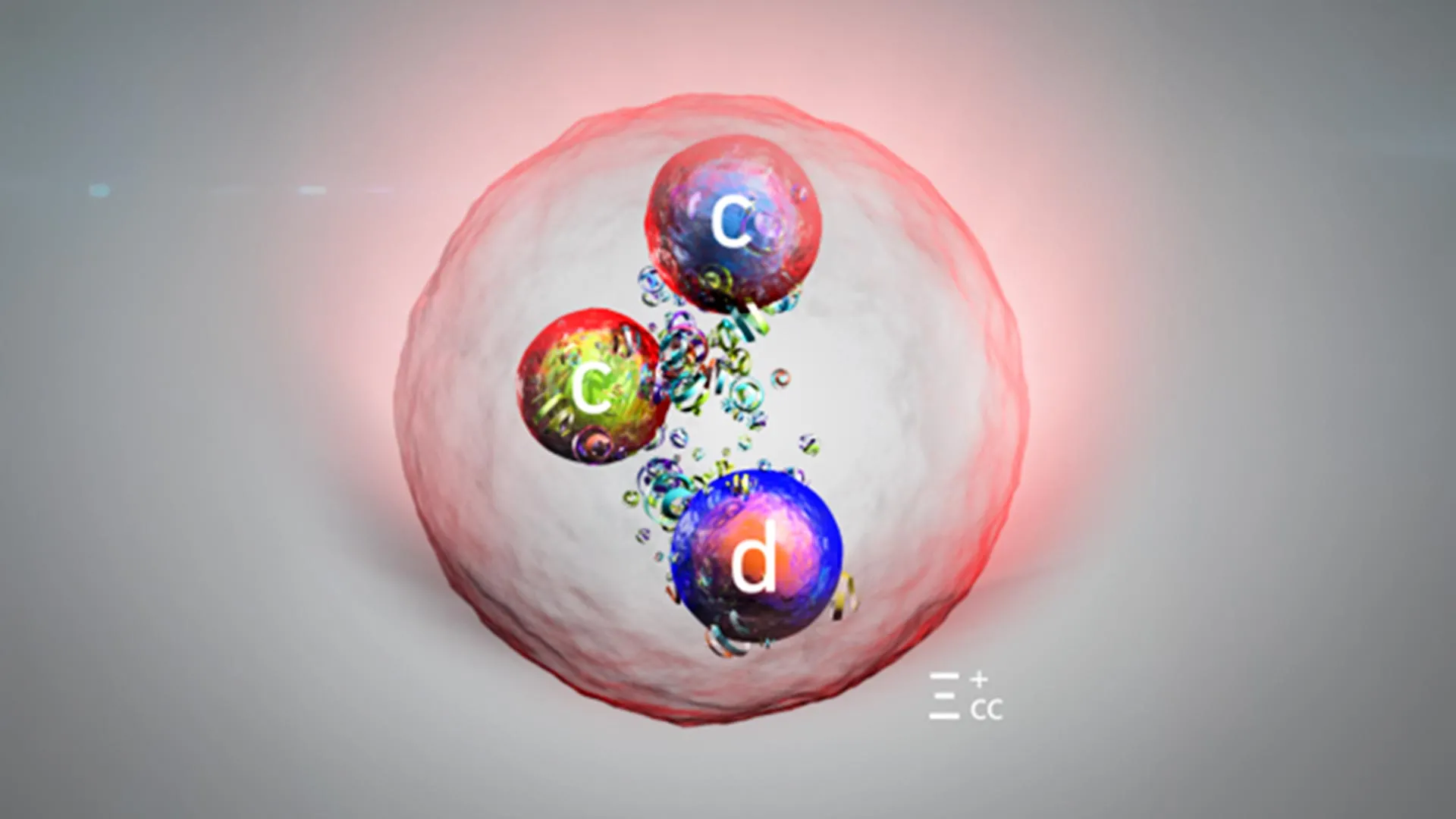
Physicists at CERN's LHCb experiment have announced the discovery of the Xi-cc-plus baryon (Ξcc⁺), an exotic subatomic particle composed of two charm quarks and one down quark, resolving a scientific mystery that has lingered since 2002 and adding the 80th known hadron to the catalog of particles discovered at the Large Hadron Collider. The finding, presented at the prestigious Rencontres de Moriond Electroweak conference on March 17, was confirmed at a statistical significance of 7-sigma — roughly equivalent to a one-in-a-trillion chance of being a statistical fluke — far exceeding the 5-sigma threshold required for a discovery claim in particle physics.
The Xi-cc-plus's unusual structure sets it apart from ordinary matter. While a proton is made of two up quarks and one down quark, the new particle replaces those two up quarks with two much heavier charm quarks, making it approximately four times as massive as a proton. Despite that extra mass, it is extraordinarily unstable, surviving for only about 40 femtoseconds — 40 quadrillionths of a second — before decaying into lighter particles. The particle's fleeting existence makes detection extraordinarily challenging: it must be identified by reconstructing its decay products from the tracks of charged particles left behind in the LHCb detector as it races through at nearly the speed of light.
"This is the first new particle identified after the upgrades to the LHCb detector that were completed in 2023," said Vincenzo Vagnoni, spokesperson for the LHCb collaboration. Those upgrades — which cost roughly $60 million and dramatically increased the detector's collision rate and data-processing capacity — were specifically designed to enable searches for heavy, short-lived exotic hadrons like the Xi-cc-plus. Vagnoni said the discovery opens "a new chapter" in studying doubly heavy baryons, a class of particles that quantum chromodynamics — the theory of the strong nuclear force — predicts should exist but which have been almost impossible to produce and detect at sufficient quantities to claim a confident discovery.
The story of the Xi-cc-plus stretches back to 2002, when physicists at Fermilab's SELEX fixed-target experiment reported tantalizing hints of a similar doubly charmed baryon. Those results were never confirmed by other experiments, and the observed mass differed from theoretical predictions, casting doubt on the entire claim. The LHCb's confirmation at 7-sigma not only establishes the particle's existence beyond doubt but pins down its mass at approximately 3,621 MeV/c² — consistent with most lattice QCD calculations — suggesting that the earlier SELEX result may have been a statistical artifact or a different, misidentified particle entirely. For the physics community, it closes a two-decade chapter of ambiguity.
The discovery has broad implications for understanding quantum chromodynamics at a fundamental level. Because the Xi-cc-plus contains two heavy charm quarks and one light down quark, the two charm quarks orbit each other in a compact core while the single light quark circulates around them in a much larger orbit — a structure that physicists have compared to a microscopic hydrogen atom, with the two-charm core acting as the nucleus and the light quark as the electron. This arrangement makes the Xi-cc-plus an ideal laboratory for testing QCD predictions about how the strong force operates across different distance scales. CERN plans to accelerate future LHCb upgrades, with a tenfold increase in collision data expected by 2030.