CERN Discovers a Particle Four Times Heavier Than a Proton Made of Two Charm Quarks — The 80th Hadron Found at the LHC
The upgraded LHCb detector at the Large Hadron Collider has observed the Ξcc⁺ (Xi-cc-plus), a doubly charmed baryon predicted by theory but disputed for two decades, with 7-sigma confidence — resolving a long-standing mystery and giving physicists a new probe of the strong nuclear force.

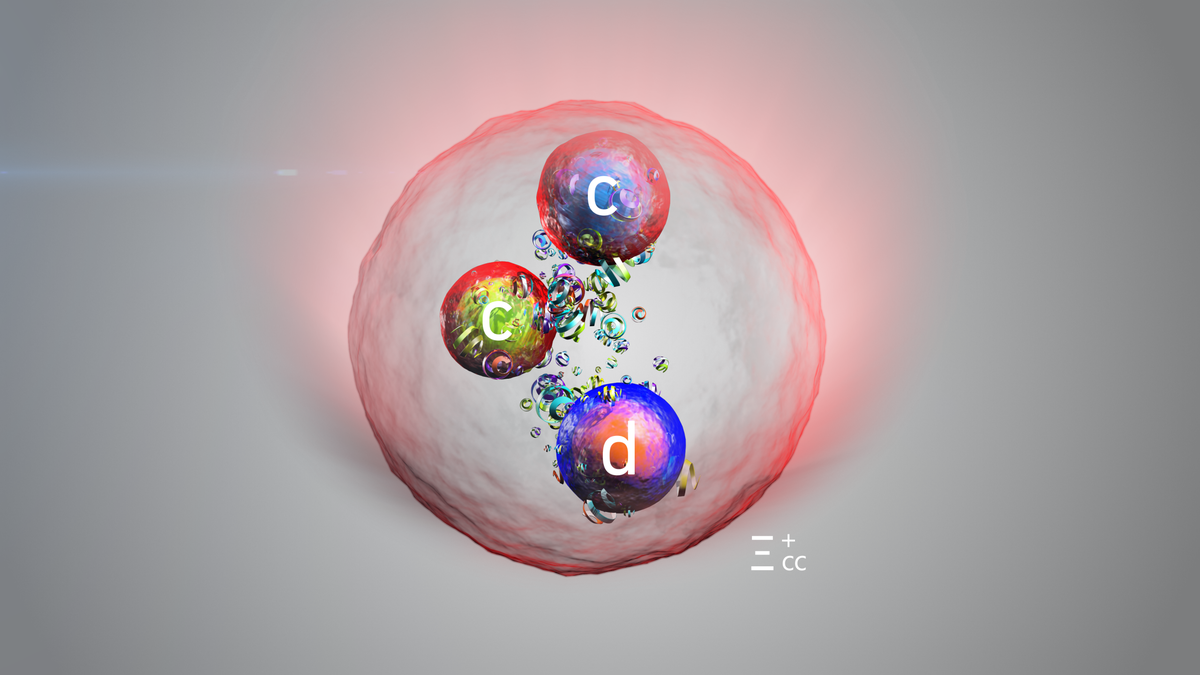
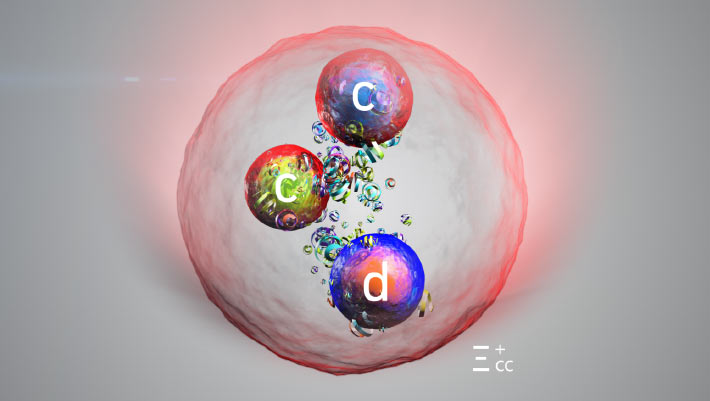
Scientists at CERN's Large Hadron Collider announced this week the discovery of a new subatomic particle — a doubly charmed baryon known as the Ξcc⁺ (Xi-cc-plus) — a particle four times heavier than a proton and composed of two of the heaviest quarks nature produces. The discovery, the first from the laboratory's upgraded LHCb detector, opens a new window into the strong nuclear force that binds all visible matter together and resolves a two-decade-long controversy over whether the particle existed at all.
The discovery was announced at the Rencontres de Moriond electroweak physics conference in La Thuile, Italy, by the LHCb Collaboration, one of the four main experiments at the Large Hadron Collider. The team observed approximately 915 events consistent with the Ξcc⁺ particle decaying into three lighter particles — a Λc⁺, a kaon, and a pion — in proton-proton collision data collected during LHC Run 3 in 2024. The statistical significance of the signal exceeded 7 sigma, well above the 5-sigma threshold required to claim a particle discovery in physics. The particle's measured mass came in at 3619.97 ± 0.83 ± 0.26 MeV/c², consistent with theoretical predictions from quantum chromodynamics, the theory governing the strong force.
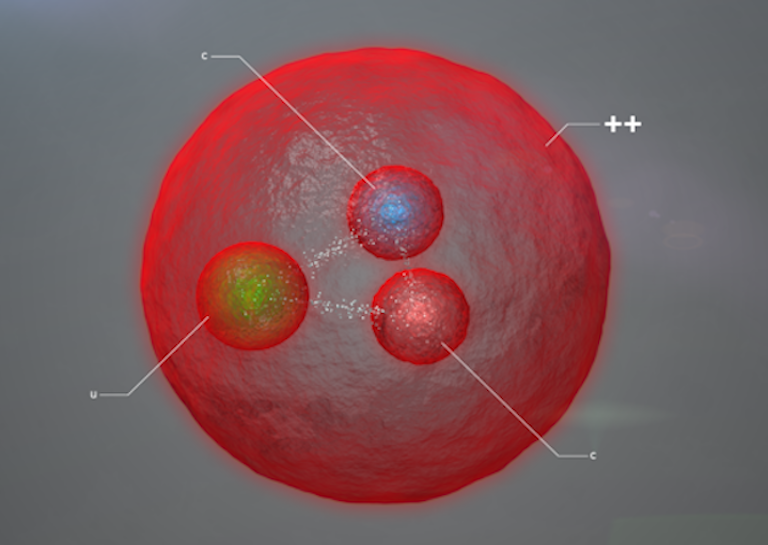
The Ξcc⁺ is the second "doubly charmed baryon" ever detected. Its partner, the Ξcc⁺⁺ (which contains two charm quarks and an up quark rather than a down quark), was discovered by LHCb in 2017 and confirmed in subsequent measurements. Charm quarks are among the heaviest of the six quark flavors, and a particle containing two of them is extraordinarily rare and short-lived — with a predicted lifetime approximately six times shorter than its 2017 partner. That property made it exceptionally difficult to find, and contributed to decades of uncertainty. An earlier claim of the particle's observation by Fermilab's SELEX experiment in 2002 had suggested a very different mass, one that disagreed with theory; the new LHCb measurement definitively resolves that discrepancy, confirming the theoretical predictions. "This is the first discovery by the upgraded LHCb detector, and it's a real demonstration of its power," said Vincenzo Vagnoni, LHCb spokesperson, at the Moriond conference.
The discovery brings the total number of hadrons — composite subatomic particles made of quarks — discovered by LHC experiments to 80, a remarkable tally that has essentially confirmed the framework of quantum chromodynamics across a vast range of particle types. CERN Director-General Mark Thomson called the discovery "a beautiful example of the scientific return" from the substantial investment in the detector upgrade, which was completed in 2023 and significantly increased the rate at which LHCb can record events. The upgrade made it possible to identify the Ξcc⁺ despite its extremely short lifetime, because the detector can now reconstruct thousands of more rare decay chains per second than it could previously.
Physicists will use measurements of the Ξcc⁺'s properties — its precise mass, lifetime, decay modes, and production rate — to test quantum chromodynamics at a level of precision that was previously impossible. The doubly charmed baryons are of particular theoretical interest because their structure is dominated by the heavy charm quarks, which move slowly enough to be described using approximations similar to those used in the hydrogen atom. That makes them powerful laboratories for testing QCD without the complications introduced by the lighter, faster-moving quarks found in ordinary protons and neutrons. The LHCb team is already analyzing additional Run 3 data and expects to publish a precise lifetime measurement of the Ξcc⁺ later this year, a result that could probe the boundaries of the Standard Model of particle physics.