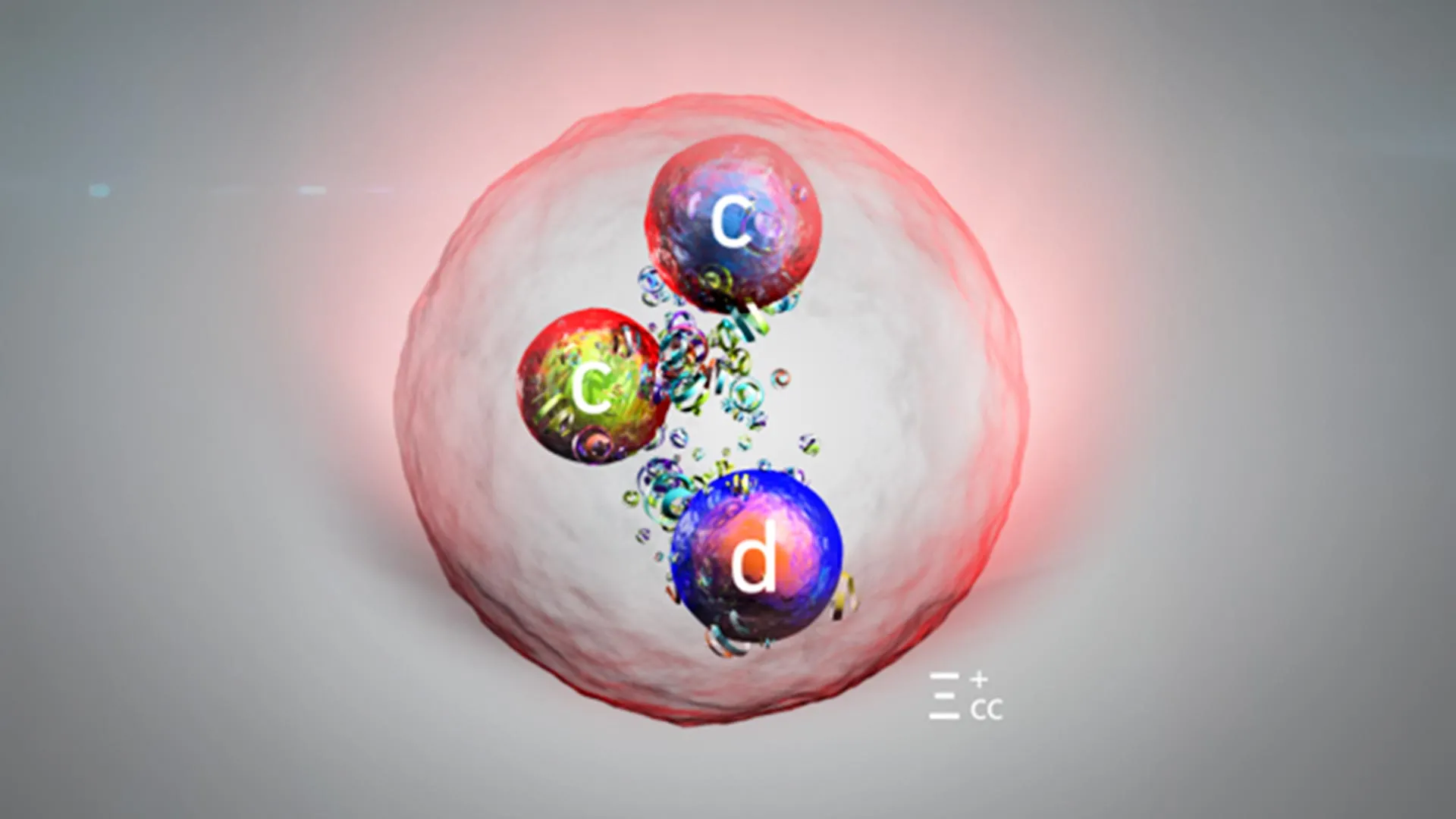
CERN Discovers New Doubly Charmed Particle That Could Crack One of Physics' Hardest Problems
The LHCb experiment has observed the Ξcc⁺ particle — containing two charm quarks — with 7-sigma confidence, opening a precision window on the strong nuclear force that binds all atomic matter.
Physicists at CERN's LHCb experiment announced Monday the discovery of a new subatomic particle — the Ξcc⁺ (pronounced Xi-cc-plus) — containing two charm quarks and one down quark, a combination that has never been observed before in nature and that promises to test physicists' understanding of the strong nuclear force at a fundamental level. The discovery, based on proton-proton collision data from Large Hadron Collider Run 3, recorded with a significance of more than 7 sigma — far above the 5-sigma threshold the physics community requires before claiming a discovery — and represents the first major new particle found using the upgraded LHCb detector installed in 2022.
The particle weighs in at approximately 3,620 MeV/c² — roughly four times the mass of a proton — and owes its heft to the two heavy charm quarks at its core. In a normal proton, two of the three constituent quarks are the lightest variety, the "up" quark; in the Ξcc⁺, those two up quarks are replaced by charm quarks, each roughly 1,500 times more massive than an up quark. The result is a particle so dense that its two charm quarks are thought to orbit each other in a tightly bound "diquark" system at the center of the particle, while a lighter down quark swirls around the outside — an arrangement that physicists say resembles, at the subatomic scale, nothing so much as a hydrogen atom, with the diquark playing the role of the nucleus and the down quark serving as the electron.
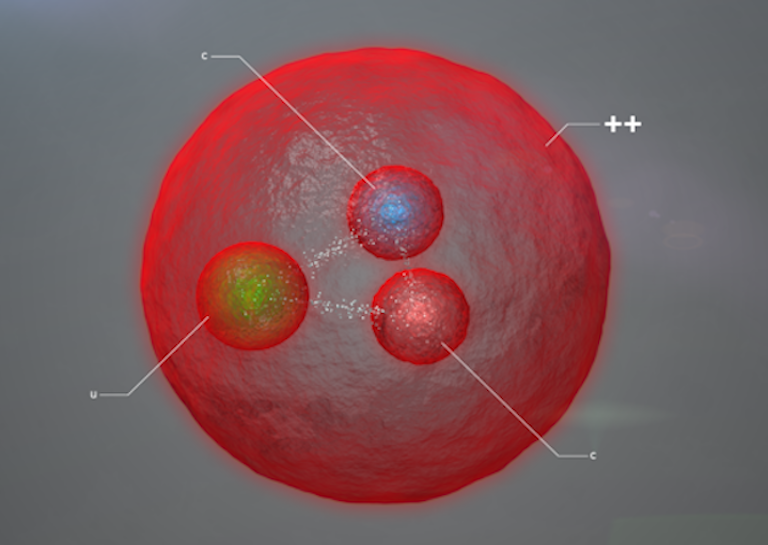
Physicists had actually observed a related doubly charmed particle before: in 2017, the same LHCb collaboration announced the Ξcc⁺⁺ (Xi-cc-plus-plus), which replaces the down quark with an up quark. But the Ξcc⁺ announced Monday is distinct — and, in some ways, more interesting. Theoretical models predict that the Ξcc⁺ should have a significantly shorter lifetime than its sibling, because the combination of two charm quarks and one down quark opens up decay pathways that are suppressed in the doubly-charmed particle with two charm quarks and an up quark. Pinning down that lifetime precisely — which will require accumulating far more data than the roughly 915 candidate events identified in Monday's analysis — will give theorists a stringent new test of quantum chromodynamics, the mathematical theory that describes how quarks bind together via the strong force.
"This is exactly the kind of particle that stress-tests our models," said Dr. Niels Tuning, physics coordinator for the LHCb experiment, in a statement released by CERN Monday. "The strong force is the least well-understood of the fundamental forces at the quark level, and doubly heavy baryons are one of the best windows we have into it." The discovery matters because the strong force — which binds quarks into protons and neutrons, and which ultimately holds atomic nuclei together — is governed by rules that are devilishly hard to solve mathematically. While the theory (quantum chromodynamics, or QCD) is well-established, calculating its predictions for complex multi-quark systems requires enormous computational effort. Particles with two heavy quarks provide especially clean experimental targets because the heavy quarks move slowly relative to the lighter quark, allowing theorists to apply certain approximation techniques that would fail for lighter systems.
The LHCb detector, nestled in a cavern 100 meters below the Franco-Swiss border near Geneva, was specifically designed to study particles containing heavy quarks. Its upgrade — completed in 2022 at a cost of roughly 200 million Swiss francs — increased its data collection rate by a factor of five, enabling the analysis that produced Monday's discovery. The collaboration, which involves more than 1,400 physicists from 22 countries, expects to collect enough data during LHC Run 3 (which runs through 2026) to measure the Ξcc⁺ lifetime to a precision of a few percent. "The Standard Model makes a clear prediction," said Dr. Sheldon Stone of Syracuse University, one of the analysis leads. "We're going to test it — and if the lifetime is off, that would be one of the most exciting hints of new physics we've seen in years."