CERN's LHCb Discovers New Doubly Charmed Baryon, Pushing Particle Count to 80
The Xi-cc-plus particle — four times heavier than a proton and built from two charm quarks — was detected at 7 sigma significance using Run 3 collision data and the upgraded LHCb detector.

Physicists at CERN's Large Hadron Collider have discovered a new subatomic particle resembling a supercharged cousin of the proton — one never before observed and one that carries fresh clues about the strong nuclear force, the most powerful fundamental force in nature. The LHCb Collaboration announced the discovery of the Xi-cc-plus particle, known formally as Ξcc⁺, on March 17, 2026, at the Moriond Conference in La Thuile, Italy. The statistical significance of the detection was 7 sigma, comfortably exceeding the 5 sigma threshold that particle physicists require before formally claiming a new particle discovery.
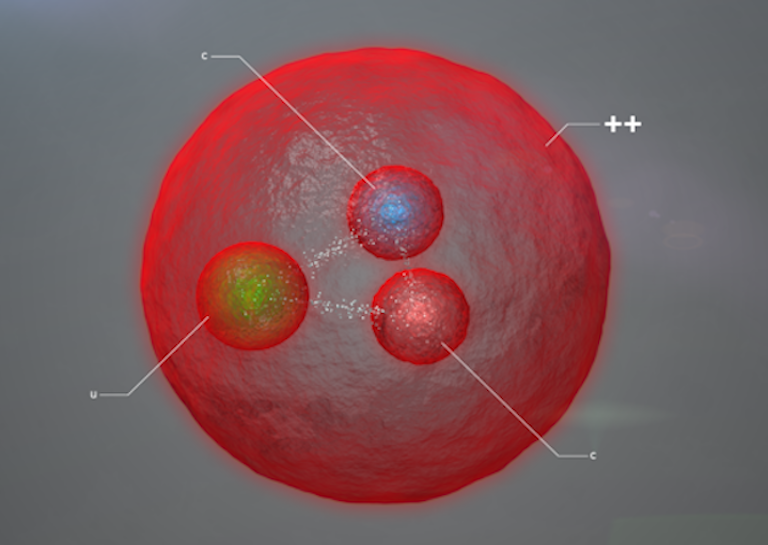
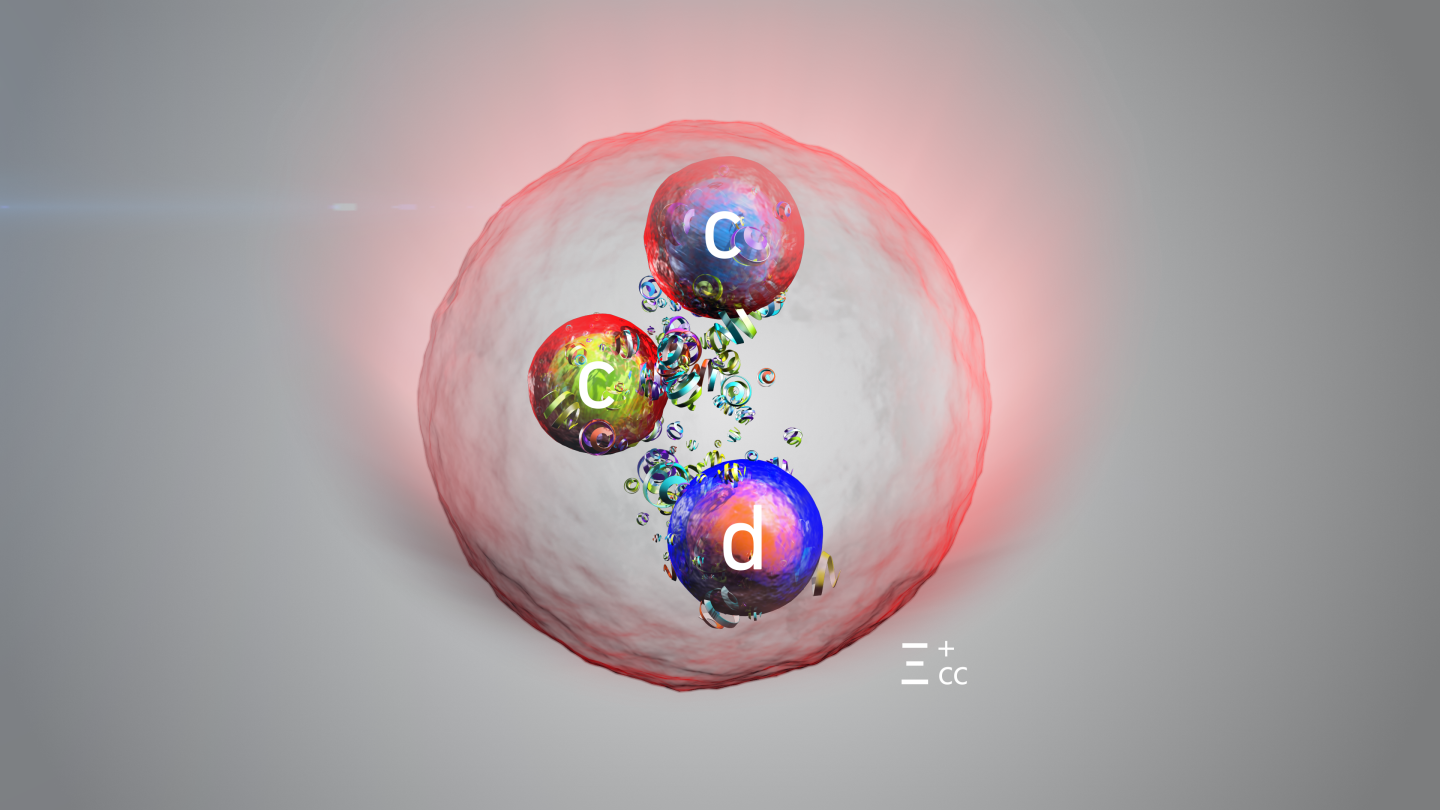
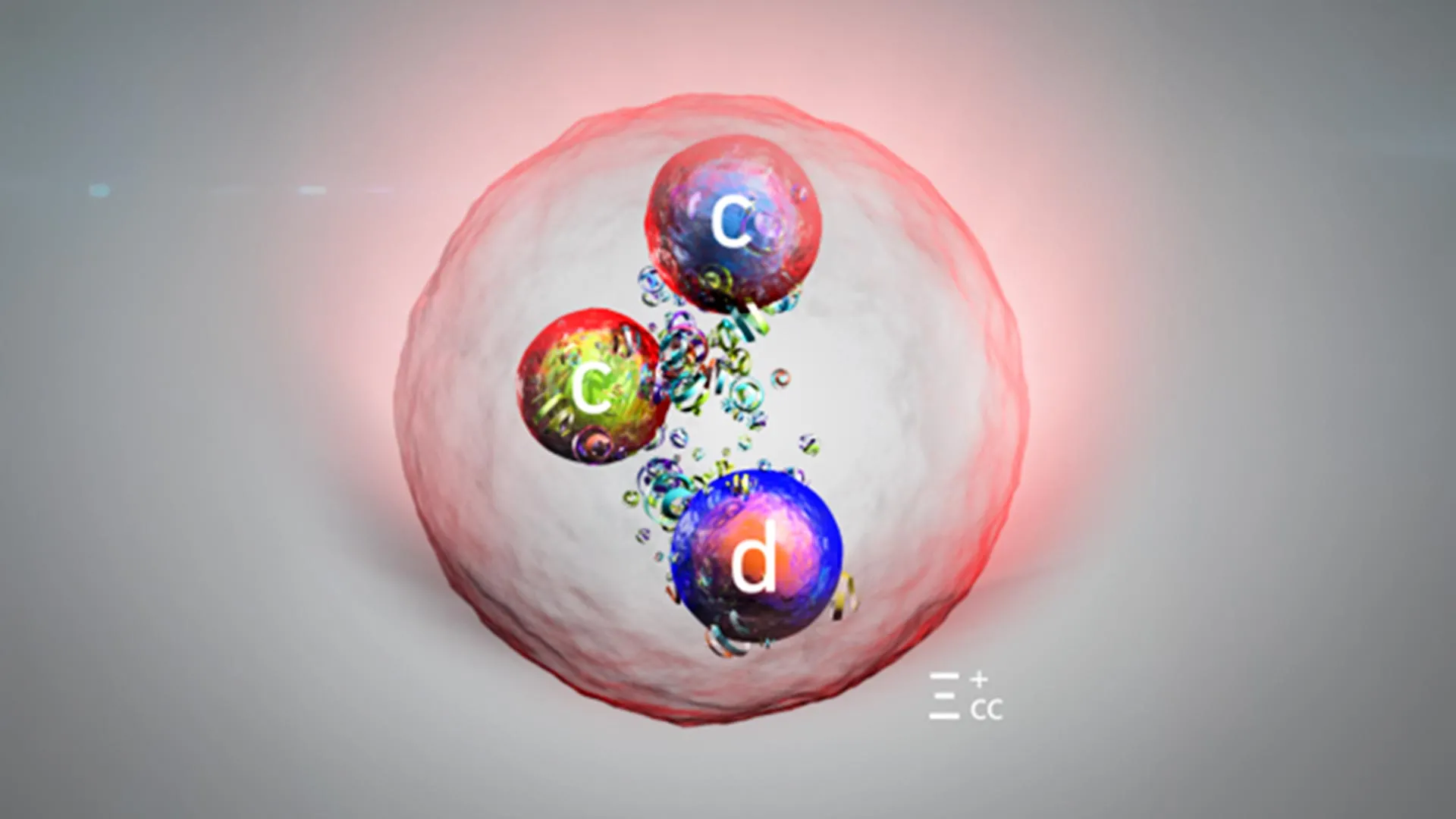
The Ξcc⁺ is a baryon — the same family of composite particles that includes the protons and neutrons making up every atomic nucleus in the universe. While an ordinary proton contains two up quarks and one down quark, the Ξcc⁺ substitutes two heavy charm quarks for the lighter up quarks, with one down quark remaining. Because charm quarks are dramatically heavier than up quarks, the Ξcc⁺ is approximately four times heavier than a proton despite being built from the same number of quarks. That extreme mass difference also gives the particle an extraordinarily short predicted lifetime — roughly six times shorter than the related Ξcc⁺⁺ particle that LHCb first discovered in 2017, which contained two charm quarks and one up quark instead.
The detection required analyzing proton-proton collision data collected during LHC Run 3 in 2024, and it marks the first new particle identified using the upgraded LHCb detector completed in 2023. Researchers found the particle by observing its decay products — three specific lighter stable particles produced when the Ξcc⁺ disintegrates — and detecting a sharp, statistically unmistakable clustering of events at 3,620 megaelectronvolts, the precise energy predicted by the theoretical models of quantum chromodynamics. The peak contained approximately 915 distinct signal events above background, providing an unambiguous signature that the particle existed.
With this discovery, the total number of hadrons — composite particles built from quarks — found by LHC experiments has climbed to 80. That growing catalog is not merely an exercise in taxonomy: each new particle tests the predictive power of quantum chromodynamics and deepens understanding of why the strong force, which operates only at subatomic distances, is powerful enough to bind protons and neutrons together in atomic nuclei despite the enormous electromagnetic repulsion between positively charged particles. Understanding how doubly charmed baryons form and decay also provides a novel laboratory for testing the limits of current theoretical models.
The discovery follows nine years after the 2017 LHCb observation of the Ξcc⁺⁺ — a find that itself resolved decades of theoretical predictions and controversy. Physicists at CERN said the discovery of the Ξcc⁺ now completes a key symmetry pair predicted by QCD, with the two particles differing only in whether the third quark is an up or a down quark. The result was announced at the Moriond Conference, one of the year's most prestigious venues for results in high-energy physics, and is expected to generate a wave of new theoretical work in the coming months as physicists use the precise decay data to sharpen and stress-test their models of the strong force.