For the First Time in History, Scientists Transported Antimatter Outside a Laboratory
A CERN team trapped 92 antiprotons in a magnetic trap and drove them around the CERN campus in a truck for 30 minutes — a feat once thought impossible — marking a turning point in the quest to understand why matter dominates our universe.
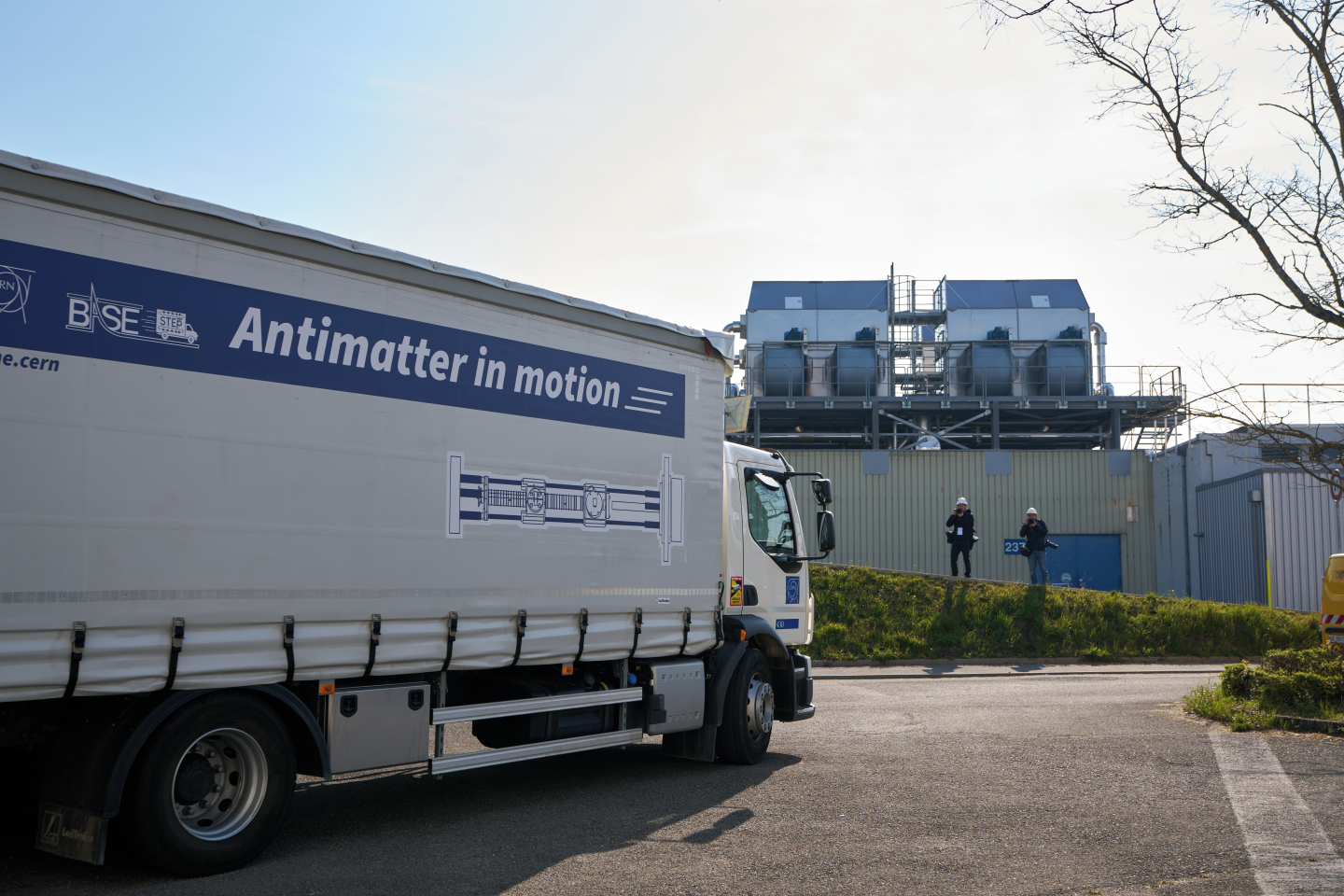
Scientists at CERN made history on March 24 by transporting antimatter outside a laboratory for the first time ever — loading 92 antiprotons into a portable magnetic trap, placing that trap on a truck, and driving it around the CERN campus near Geneva for 30 minutes. When the vehicle stopped and the antiprotons were counted, 91 of the 92 had survived the journey intact. The achievement, announced by the BASE experiment collaboration, marks a turning point in physics that researchers say could help answer one of the deepest questions in science: why does matter exist at all?
Antiparticles are the mirror images of ordinary matter particles. When antimatter meets ordinary matter, the two annihilate in a burst of energy — which is why containing and moving antiprotons is extraordinarily difficult. The BASE team's portable trap works by supercooling powerful electromagnets to –269°C, just four degrees above absolute zero, to create a magnetic bottle that suspends antiprotons in a vacuum and prevents them from touching the walls of the container. The entire apparatus — roughly a one-metre cube weighing around 1,000 kilograms — maintains its cryogenic conditions using a closed-cycle refrigeration system that requires no liquid helium to be added during operation.
The 30-minute drive around CERN's campus was the culmination of years of engineering work by Stefan Ulmer, BASE spokesperson, and his team. "We are transporting 100 antiprotons," Ulmer said, capturing the surreal scale of the achievement — a single grain of salt contains roughly a quintillion ordinary protons, yet transporting even a hundred antiprotons required a machine the size of a large refrigerator and a decade of development. The entire process, from loading the antiprotons in the trap to completing the drive and resuming experiments, took approximately three hours — comfortably within the four-hour containment window the team had calculated as safe.
The scientific motivation goes beyond the feat itself. Measurements of antiprotons made near CERN's accelerators are limited by seismic vibrations and electromagnetic noise from the machines. By transporting antimatter to quieter laboratory environments at universities, physicists hope to achieve measurements 100 to 1,000 times more precise than anything currently possible. Specifically, the BASE team wants to compare the magnetic moment of the proton with that of the antiproton to extraordinary precision — a measurement that should, according to the Standard Model of particle physics, show perfect symmetry between the two. Any deviation would constitute evidence of new physics and could begin to explain why the universe contains vastly more matter than antimatter.
The next goal is ambitious: drive antiprotons from CERN to Heinrich Heine University in Düsseldorf, Germany — an eight-hour journey — with facilities expected to be ready by 2029. The team also has plans to partner with Leibniz University Hannover. If antiprotons can survive an eight-hour international road trip, the practical barriers to a global network of precision antimatter measurement labs effectively disappear.
The experiment was published simultaneously in a paper in Nature on March 24, 2026. CERN Director-General Mark Thomson called it "a milestone that rewrites what we thought was possible" and said the achievement demonstrated that "the most exotic materials in the universe can, with sufficient ingenuity, be taken for a drive."