CERN Transports Antimatter by Road for the First Time, Carrying 92 Antiprotons 5km in a Penning Trap
Scientists at the BASE experiment loaded antiprotons into a portable cryogenic trap and drove them across the CERN campus on March 24, completing a milestone that opens the door to conducting antimatter experiments far from any particle accelerator.
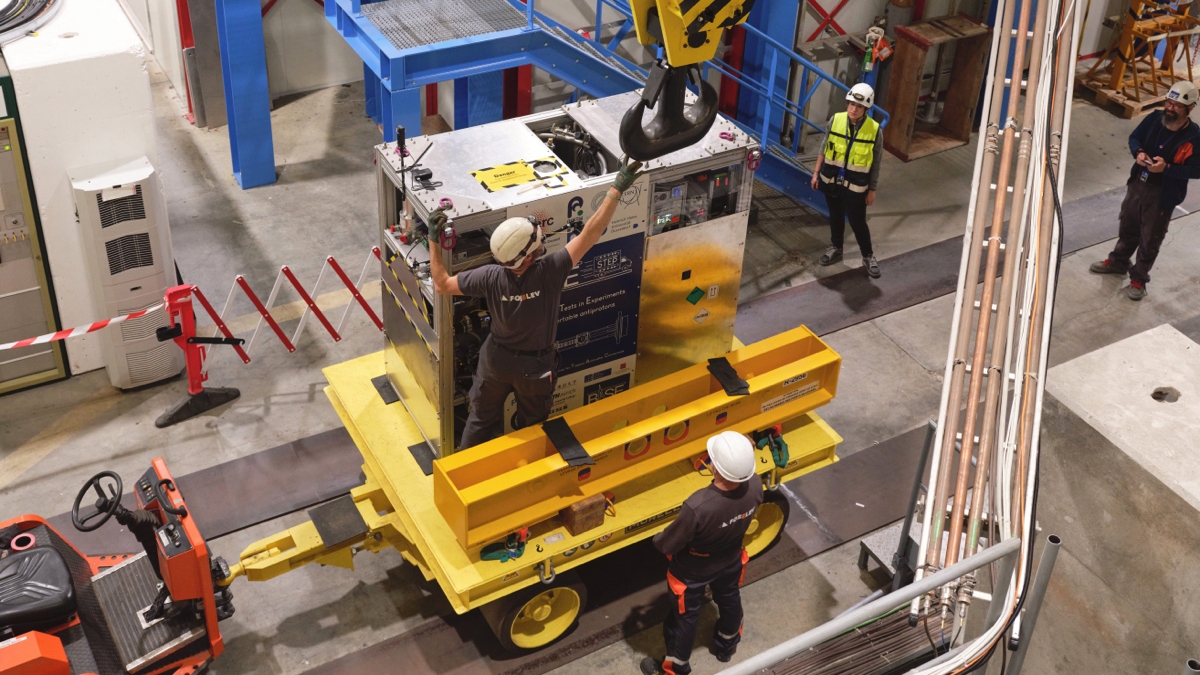
Scientists at CERN, the European particle physics laboratory near Geneva, Switzerland, transported antimatter by road for the first time in history on March 24, carrying a cargo of 92 antiprotons in a portable cryogenic trap across five kilometres of the CERN campus. The journey lasted approximately 30 minutes, the antimatter survived intact, and the physics world reacted with a mixture of excitement and disbelief — because keeping antimatter alive outside a particle accelerator long enough to drive it anywhere was, until recently, considered practically impossible.
Antimatter is the mirror image of ordinary matter. An antiproton carries the same mass as a proton but the opposite electric charge; a positron mirrors an electron. When matter and antimatter meet, they annihilate each other instantly and completely, converting their combined mass into a burst of gamma-ray energy. This annihilation makes antimatter extraordinarily difficult to study: any contact with ordinary air, any vibration, any lapse in the electromagnetic fields that hold the particles suspended, and the experiment is over in a nanosecond. Since CERN first created and trapped antihydrogen atoms in 1996, all antimatter research has depended on producing the particles at a large accelerator and studying them immediately on-site, because there was no way to transport them anywhere.
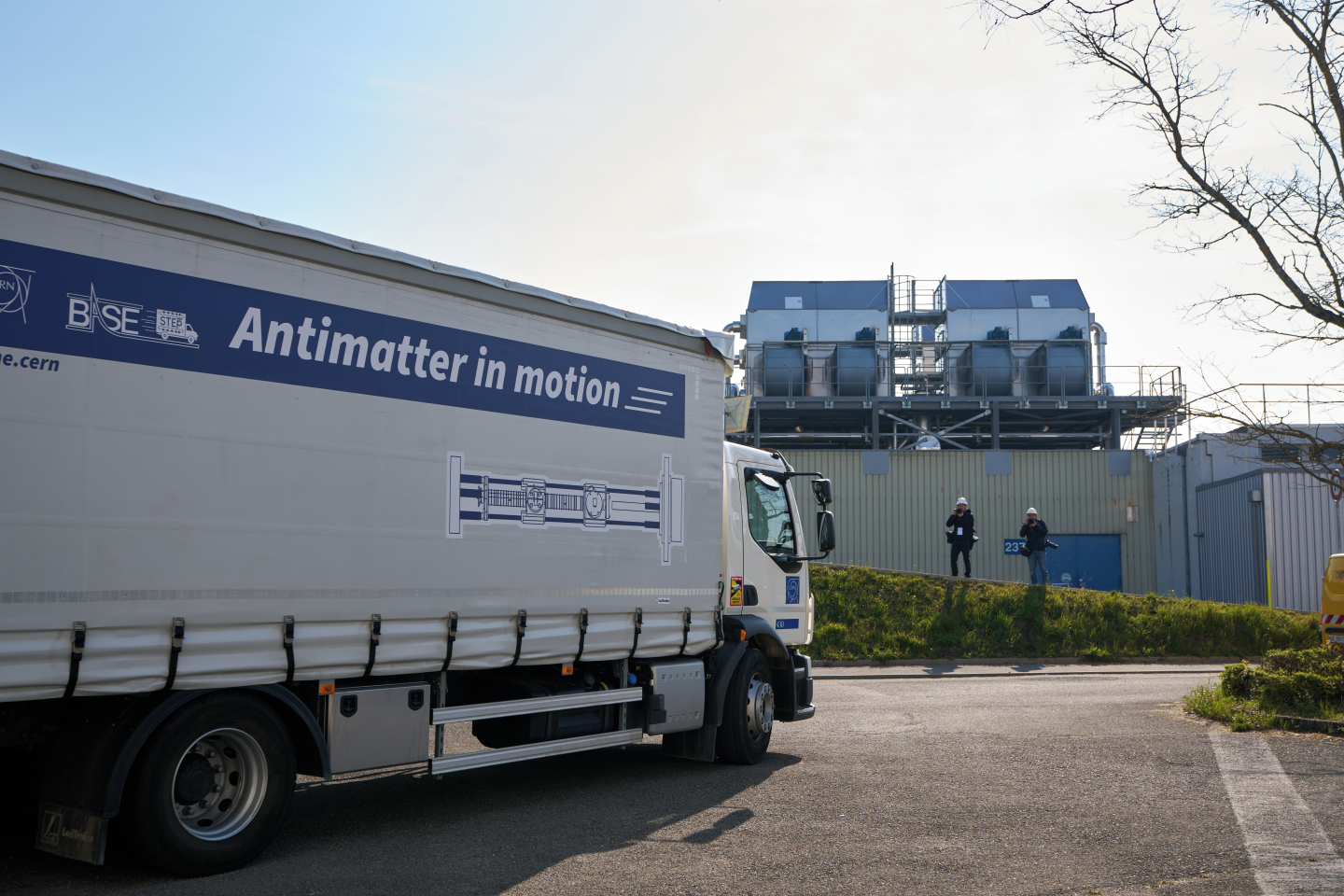
The device that changed this is called BASE-STEP — the Baryon Antibaryon Symmetry Experiment Specially Transported Antiproton Package. It weighs approximately 1,000 kilograms and uses a Penning trap: a combination of superconducting magnets and precisely shaped electric fields that confine charged particles by curving their trajectories into tight orbits. The trap is cooled with liquid helium to below 8.2 degrees Kelvin — colder than interstellar space — to suppress thermal vibrations that would knock the antiprotons out of confinement. It is compact enough to pass through standard laboratory doors and can run on supplemental cryocooler power for extended periods. The transport truck was marked 'Antimatter in Motion' and accompanied by a small escort. Lead scientist Dr. Stefan Ulmer, who heads the BASE collaboration at CERN, said watching the vehicle make its circuit of the campus was 'surreal in the best possible way.'
The goal of the exercise was not merely the milestone itself. Ulmer's team wants to transport antiprotons to Heinrich Heine University in Düsseldorf, Germany, for precision measurements that are fundamentally impossible at CERN because of magnetic field interference from the laboratory's many other experiments. 'Every time we try to measure the magnetic moment of the antiproton at CERN, we are fighting against the background noise of a dozen other machines,' Ulmer said. 'Moving the experiment to a quiet location will let us make measurements ten times more precise than anything we have achieved here.' An 8-hour road journey from CERN to Düsseldorf is the next milestone the team is working toward.
The physics motivation behind those precision measurements is nothing less than explaining why the universe exists. The Big Bang should have produced equal amounts of matter and antimatter, which would have immediately annihilated each other, leaving behind nothing but radiation — an empty universe. Something must have tipped the balance: a tiny asymmetry between the properties of matter and antimatter that allowed matter to survive. Physicists call this asymmetry CP violation. By measuring whether the antiproton's magnetic moment differs even minutely from that of the proton, BASE-STEP could detect a form of CP violation that current theories do not predict — and that might explain why, 13.8 billion years after the Big Bang, there is still something rather than nothing. The truck that drove five kilometres around CERN on March 24 was carrying, in a portable refrigerator, a small piece of the antimatter that the universe was supposed to have erased.