Astronomers Trace the Brightest Cosmic Radio Flash Ever Recorded to a Single Star-Forming Region — And It May Never Repeat
Using the CHIME Outrigger telescope array spanning from Canada to West Virginia, scientists pinpointed FRB 20250316A — nicknamed RBFLOAT — to a 45-light-year region in galaxy NGC 4141, 130 million light-years away, with the James Webb Space Telescope finding an unexpected infrared glow at the same location.
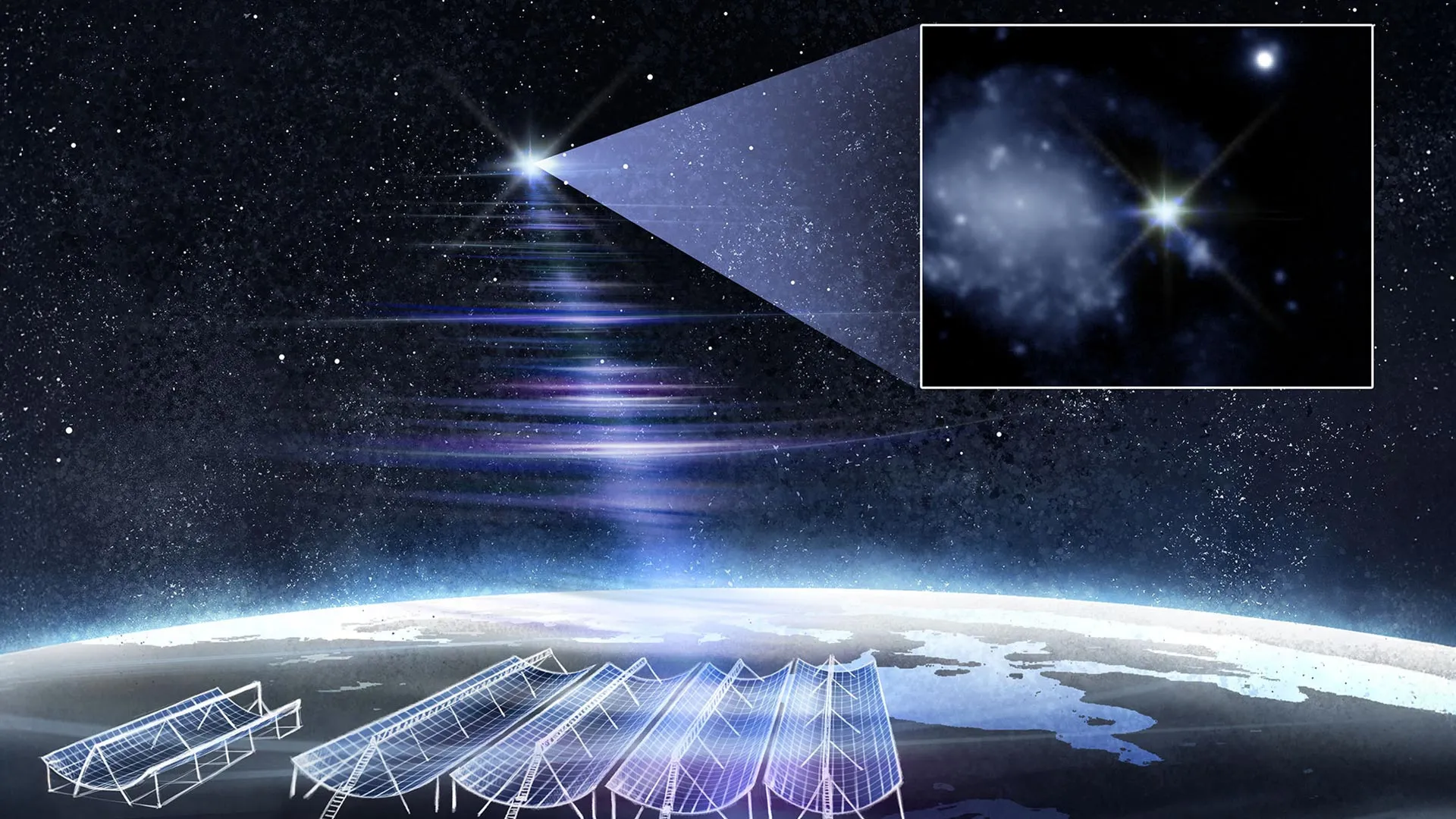
Astronomers using a new network of telescope stations stretching from British Columbia to West Virginia have traced the brightest fast radio burst ever detected to a specific star-forming region within a galaxy 130 million light-years from Earth — a precision achievement one researcher likened to "spotting a guitar pick from 1,000 kilometers away." The burst, officially designated FRB 20250316A but nicknamed RBFLOAT for "Radio Brightest Flash of All Time," was detected on March 16, 2025, by the Canadian Hydrogen Intensity Mapping Experiment telescope and its newly completed Outrigger array, and the full analysis was published in a series of papers in March 2026.
Fast radio bursts are millisecond-scale pulses of radio energy so intense they briefly outshine entire galaxies in radio wavelengths. First discovered in 2007 in archival data from the Parkes Observatory in Australia, hundreds of these mysterious flashes have now been catalogued — some repeating, some appearing to fire just once. Their precise origin remains one of astronomy's most vigorously contested puzzles: leading candidates include intense magnetic fields around neutron stars, collisions between compact objects, and exotic processes around black holes. The fundamental challenge has always been localization — without knowing precisely where a burst originated, astronomers cannot identify the physical conditions that produced it or examine the burst's host environment for clues.
RBFLOAT's exceptional brightness — it temporarily outshone every other radio source in its host galaxy, NGC 4141 in the constellation Ursa Major — gave the CHIME Outrigger network its most rigorous scientific test yet. The array combines the main CHIME telescope at the Dominion Radio Astrophysical Observatory in Penticton, British Columbia, with smaller outpost telescopes in Princeton, British Columbia, Hat Creek, California, and Green Bank, West Virginia. Together they employ a technique called Very Long Baseline Interferometry, correlating radio signals received by telescopes thousands of kilometers apart to determine a source's position with extraordinary angular precision. The result for RBFLOAT was a positional accuracy of just 45 light-years — placing the burst precisely at the outer edge of a star-forming region within NGC 4141.
What happened at that location surprised and intrigued researchers. Follow-up observations using the James Webb Space Telescope detected an unexpected faint infrared signal at the burst's exact position — consistent either with a red giant star or with a slowly fading light echo from the burst itself. The nature of that infrared signal is not yet determined, and resolving it could provide crucial clues about what physical mechanism produced RBFLOAT. Meanwhile, analysis of more than six years of archival CHIME data found no previous bursts from this position, suggesting RBFLOAT may be a one-time event rather than a repeating source.
If that non-repeating classification holds up under further study, it would carry significant theoretical weight. Astronomers have long debated whether all fast radio bursts share a common origin or whether the population is heterogeneous — some coming from the same recurring engine, others from catastrophic one-time events. "For the first time, we can do more than just detect these bursts — we can pin them to a specific neighborhood within a galaxy and go look for what's there," said one researcher involved with the CHIME/FRB Collaboration. The combination of unprecedented positional precision, an unusual infrared counterpart, and the non-repeating behavior makes RBFLOAT the most intensely studied fast radio burst in history, and a key reference event for theorists working to explain these extraordinary cosmic flashes.