Scientists Deploy Nearly 7,000 GPUs to Simulate a Quantum Chip With Atomic-Level Accuracy
Berkeley Lab's Perlmutter supercomputer modeled a full 10-millimeter quantum chip across 11 billion grid cells, a calculation that could slash the number of expensive physical prototypes needed to build next-generation quantum computers.
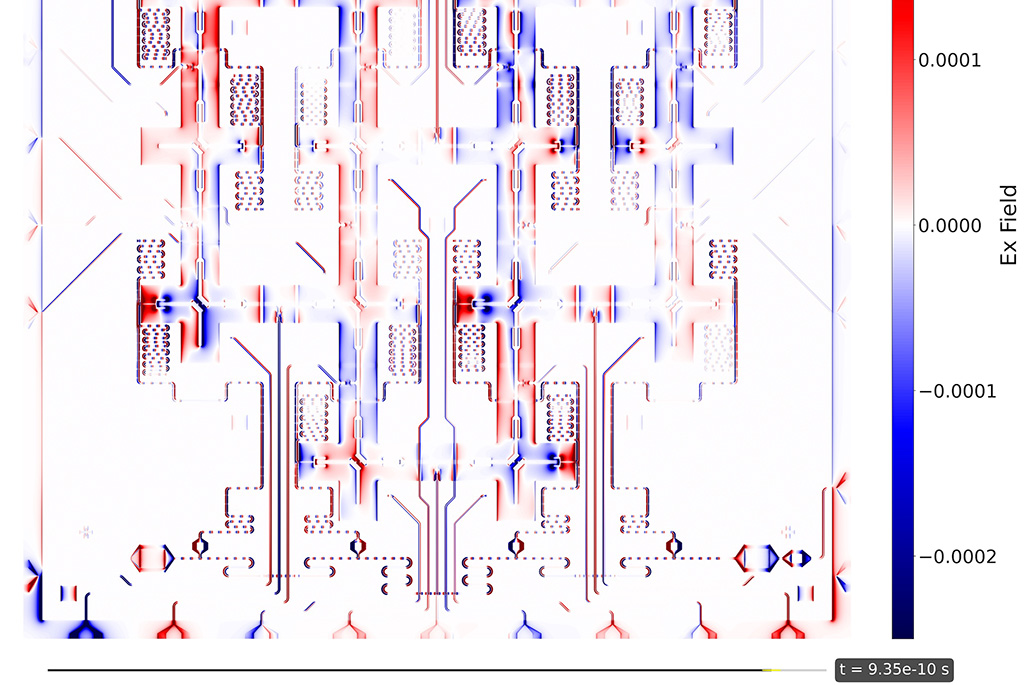
Scientists at Lawrence Berkeley National Laboratory and the University of California, Berkeley have completed one of the most computationally intensive simulations ever attempted on a quantum microchip, modeling a 10-millimeter superconducting device with features as small as one micron across 11 billion discrete grid cells — a calculation that required nearly 7,000 NVIDIA GPUs running simultaneously on the Perlmutter supercomputer for a continuous 24-hour period and could dramatically reduce the number of expensive physical prototypes required to develop next-generation quantum hardware.
The simulation was conducted on Perlmutter, the National Energy Research Scientific Computing Center's advanced GPU-based supercomputer at the U.S. Department of Energy's Berkeley Lab. The team utilized 7,168 NVIDIA A100 GPUs — nearly every GPU on the machine — working in tightly coordinated parallel. The chip itself was discretized into 11 billion grid cells and subjected to more than one million time steps of electromagnetic simulation in a continuous seven-hour computational sprint, allowing researchers to evaluate three different qubit circuit configurations in a single day. The scale and physical fidelity of the simulation far exceeded any prior effort to model a full quantum chip on classical computing hardware.
Previous approaches to quantum chip design had relied on simplified 'black box' models that treated individual qubits and their interconnects as idealized theoretical elements. The Berkeley approach instead models every physical feature of the chip from first principles — the precise geometry of superconducting resonators, the exact electromagnetic behavior of Josephson junctions, and the dielectric properties of the substrate materials at cryogenic operating temperatures. This level of physical detail allows researchers to observe subtle electromagnetic crosstalk between adjacent qubits that would degrade coherence in the final device, identify manufacturing variations before they are fabricated, and predict how the chip will actually behave at millikelvin temperatures well before a single wafer enters the cleanroom.
The implications for the quantum computing industry are substantial. Fabricating a superconducting quantum chip currently requires months of cleanroom processing, cryogenic testing infrastructure, and iterative physical refinement — each fabrication cycle costing hundreds of thousands of dollars. If simulation-based optimization can eliminate even one or two physical prototype iterations from the development cycle, the resulting time and cost savings could meaningfully accelerate the path from laboratory-scale demonstrations to deployable quantum processors. The research team, which announced the results on March 17 at the Rencontres de Moriond conference, is already working with quantum hardware companies to apply the simulation framework to chips with higher qubit counts.
Dr. Kasra Nowrouzi, one of the lead authors, described the goal as creating a 'digital twin of a quantum chip' — a simulation faithful enough to serve as a reliable design proxy throughout the entire development pipeline. The Perlmutter supercomputer's architecture, featuring high-bandwidth interconnects between GPU nodes optimized for irregular sparse communication patterns, was well-suited to the simulation's requirements. The work represents a milestone in the broader strategy of using classical supercomputing resources to bootstrap the development of quantum processors — which, once they reach sufficient scale and error correction, are expected to surpass classical systems on commercially valuable computational tasks including drug discovery, materials science, and financial optimization.