Astronomers Directly Measure a Rogue Planet's Mass for the First Time in History
Using gravitational microlensing and the retired ESA Gaia observatory's parallax data, scientists pinned down the mass and distance of a free-floating world drifting 9,800 light-years from Earth.

For the first time in the history of astronomy, scientists have directly measured both the mass and distance of a free-floating planet — a world adrift in interstellar space with no parent star — providing a precise portrait of a class of objects that were, until recently, almost entirely beyond the reach of direct measurement. The planet, approximately 22 percent the mass of Jupiter, drifts roughly 9,800 light-years from Earth toward the center of the Milky Way. The findings, published in the journal Science and led by Subo Dong of Peking University, mark a milestone in the study of so-called 'rogue planets,' objects that were either ejected from planetary systems or possibly formed in isolation in the cold reaches of interstellar space.
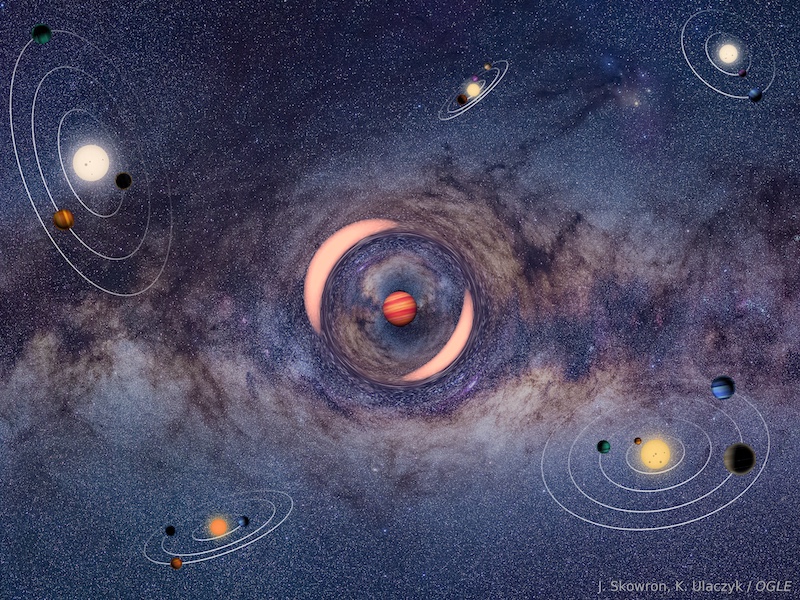
The discovery relied on a rare astronomical phenomenon called gravitational microlensing. When the rogue planet passed almost directly in front of a distant background star, its gravity briefly magnified the star's light in a detectable way — a microlensing event catalogued as KMT-2024-BLG-0792/OGLE-2024-BLG-0516. Microlensing events have been used for years to detect rogue planets, but they typically suffer from a fundamental limitation: because a lone lensing object produces a characteristic light curve that depends on both mass and distance in an entangled way, it has been impossible to separately determine either property without additional information.
What made this event uniquely valuable was the fortuitous involvement of the European Space Agency's now-retired Gaia space observatory. Gaia, which spent over a decade mapping the positions and motions of more than a billion stars from its vantage point in space, observed the same microlensing event from a different geometric position than Earth-based telescopes. That difference in viewpoint — a technique called parallax — provided precisely the additional data needed to break the mass-distance degeneracy that has long stymied rogue planet characterization. Gaia observed the event six separate times over 16 hours near the peak of the magnification, capturing data of sufficient precision for Dong's team to pin down both the planet's mass and its distance with confidence.
The result: a world roughly comparable to Saturn in mass, though closer to Jupiter in terms of its likely composition, traveling alone through the stellar crowds of the inner Milky Way. Analysis of the microlensing data suggests the planet most likely formed within a protoplanetary disk around a star and was subsequently ejected through gravitational interactions, a fate that theoretical models predict for a significant fraction of all planets that form in the galaxy. Some estimates suggest there could be trillions of rogue planets in the Milky Way alone, outnumbering stars, but direct evidence has been scarce.
The significance of the measurement extends beyond this single object. The technique demonstrated in this study — combining Earth-based microlensing surveys with simultaneous space-based parallax observations — provides a template for future surveys. NASA's Nancy Grace Roman Space Telescope, scheduled to launch in the late 2020s, is designed specifically to conduct wide-area microlensing surveys and will carry out parallax measurements in a systematic way for the first time. Astronomers expect Roman to detect thousands of rogue planet candidates; the Gaia parallax method validated in this study will help determine which of those detections can be converted into precise mass measurements, finally putting observational constraints on the theoretical predictions about how many free-floating planets the galaxy contains.