Australian Physicists Observe Atoms Existing in Two Places at Once — A Quantum First
ANU researchers have demonstrated Bell correlations in the momentum of helium atoms for the first time, using massive particles instead of light to test quantum entanglement.

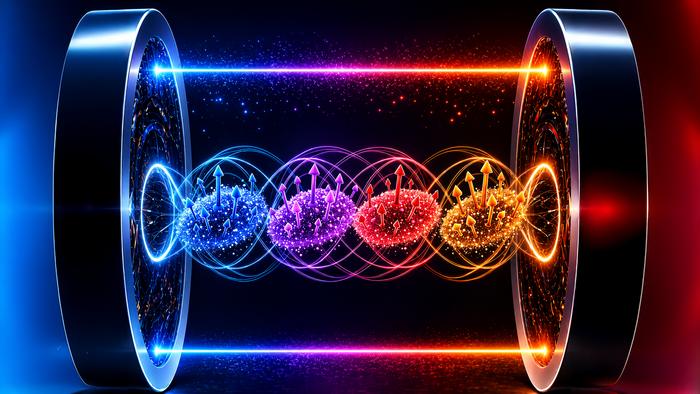
Physicists at the Australian National University have achieved what many considered one of the most difficult experiments in modern quantum physics: observing pairs of massive atoms existing in two places simultaneously, demonstrating quantum entanglement in the motion of matter rather than just light. The experiment, published in Nature Communications in February and gaining widespread attention this month, marks the first time Bell correlations — the definitive signature of quantum entanglement — have been measured in the kinematic properties of massive particles, opening a new avenue for testing whether quantum mechanics and gravity can be unified.
The breakthrough came from a team led by Dr. Sean Hodgman and PhD researcher Yogesh Sridhar at ANU's Research School of Physics. Their experiment used clouds of ultracold helium atoms suspended in a trap of magnetic fields. When the clouds passed through each other, atoms collided and exchanged momentum — and across more than 35,000 experimental runs, the team measured the resulting pairs to confirm they were entangled, meaning the momentum of one atom was instantaneously correlated with its partner regardless of the distance separating them.
"You can read about it in a textbook, but it's really weird to think that a particle can be in two places at once," Hodgman said, describing the moment researchers confirmed the results. Lead author Sridhar emphasized how long scientists had attempted this specific demonstration: "Experimentally, it's extremely hard to demonstrate this. Several people have tried in the past to show these effects, and they have always come short." The team succeeded by using precise magnetic field control to cool the helium to just nanokelvins above absolute zero, conditions that allow quantum effects to dominate over thermal noise.
The distinction between atoms and photons is scientifically profound. Photons — particles of light — are massless and travel near the speed of light, making them ideal carriers of quantum information but poor proxies for the objects that make up ordinary matter. Atoms have mass. They respond to gravity. That means ANU's experiment creates, for the first time, conditions where entangled particles are subject to both quantum mechanical effects and gravitational influence simultaneously — the exact intersection where physicists believe a unified theory of quantum gravity must operate.
General relativity, Einstein's theory of gravity, describes the universe at large scales — planets, black holes, the curvature of spacetime. Quantum mechanics governs the subatomic world with extraordinary precision. Despite decades of effort, no one has produced a theory that reconciles the two frameworks. Experiments involving entangled massive particles could provide precisely the observational data needed to constrain competing theories of quantum gravity, some of which predict that entanglement itself should break down at the boundary where quantum and gravitational effects become comparable.
The research opens several practical experimental pathways. Because atoms with entangled momentum can be manipulated in gravitational fields in ways that photons cannot, future experiments could use similar techniques to probe gravitational effects on quantum coherence — testing whether gravity causes decoherence, as some theories predict, or whether quantum entanglement survives gravitational influence intact. Hodgman's group is already planning follow-up experiments designed to probe these questions directly. The results suggest that the long-sought Theory of Everything — a single framework that incorporates all fundamental forces including gravity — may be approachable through a new experimental door that this experiment has now opened.