Scientists Deployed 7,000 GPUs to Simulate a Quantum Chip in Unprecedented Detail, Cutting the Path to Quantum Advantage
Berkeley Lab researchers used the Perlmutter supercomputer to model a 10-millimeter quantum chip across 11 billion grid cells, catching design flaws before fabrication in a breakthrough that could shorten the quantum computing race by years.

Researchers at Lawrence Berkeley National Laboratory and the University of California, Berkeley have completed what they describe as the most detailed simulation ever performed of a quantum microchip, deploying nearly 7,000 NVIDIA GPUs on the Perlmutter supercomputer to model a 10-millimeter quantum chip in extraordinary physical detail — capturing not just its logical behavior but the actual electromagnetic behavior of the materials, wiring layouts, and resonator structures inside it. The work, published this month and drawing wide attention in the quantum computing community, represents a potential inflection point in how quantum hardware is designed.
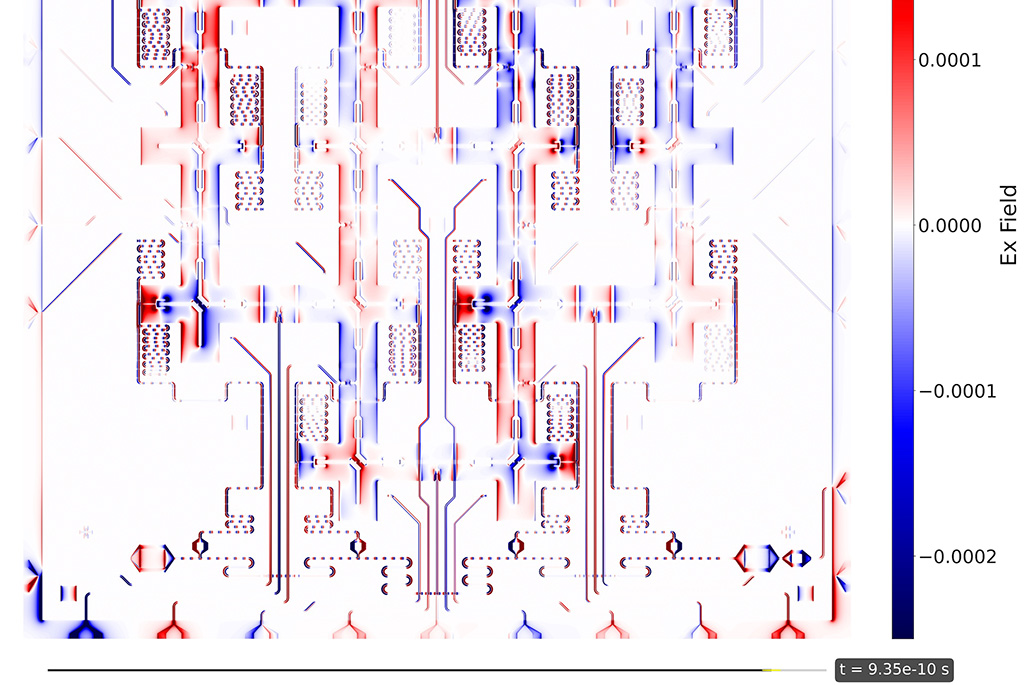
The simulation, run using a software tool called ARTEMIS developed at Berkeley Lab, discretized the chip into 11 billion grid cells and ran more than one million time steps in just seven hours — evaluating three different circuit configurations in a single day of computing. Unlike earlier simulation approaches that treated quantum chips as "black boxes" and approximated their behavior mathematically, the ARTEMIS method solves Maxwell's equations in the time domain, tracking exactly how electromagnetic waves propagate and interact inside the chip's physical structure. That level of fidelity reveals phenomena that simplified models miss: signal coupling between nearby components, unwanted electromagnetic interference between qubits, and subtle nonlinear effects that can cause quantum gates to fail.
The practical significance is enormous. Building a quantum chip is a months-long, multimillion-dollar process that requires fabrication in specialized cleanrooms. When a new design turns out to have unexpected performance problems — which happens frequently — researchers must diagnose the issue, revise the design, and fabricate a new chip, adding more months and more cost to development timelines. The ability to simulate a chip with the fidelity achieved at Berkeley Lab means that many design flaws can be caught and corrected before a single wafer is ever etched. As one researcher put it: "The computational model predicts how design decisions affect electromagnetic wave propagation in the chip, preventing problems before they occur in real hardware."
The simulation was performed on Perlmutter, a Department of Energy facility at the National Energy Research Scientific Computing Center (NERSC), using 7,168 NVIDIA GPUs running in concert for approximately 24 hours. The scale of the computation — processing 11 billion spatial grid cells across a million time steps — required careful management of data movement between GPU memory banks and demanded a level of parallel programming expertise that few research groups possess. The team has already begun working with experimental quantum hardware groups to compare actual chip performance against the simulation predictions, a validation process that will both confirm the model's accuracy and guide further refinements.
The work arrives at a moment when the race to build a fault-tolerant quantum computer has intensified sharply. Google, IBM, Microsoft, and a growing number of well-funded startups have all announced ambitious timelines for achieving "quantum advantage" — the point at which a quantum processor can solve meaningful real-world problems faster than any classical computer. A key bottleneck in reaching that milestone is reducing the error rates of quantum gates, which are heavily influenced by the electromagnetic environment inside the chip. Better simulation tools that accurately capture that environment could shorten development cycles by years, potentially changing the competitive calculus in what has become one of the most watched technology races of the decade.