Penn Engineers Coax Light Itself Into Talking to Light Using Exciton-Polaritons, Switching Signals With Just 4 Femtojoules in Step Toward Optical AI Chips
Bo Zhen's team at the University of Pennsylvania reports in Physical Review Letters that hybrid light-matter quasiparticles trapped in atomically thin semiconductors interact strongly enough to perform all-optical switching, the missing ingredient for photonic processors that could replace electrons in artificial-intelligence accelerators.

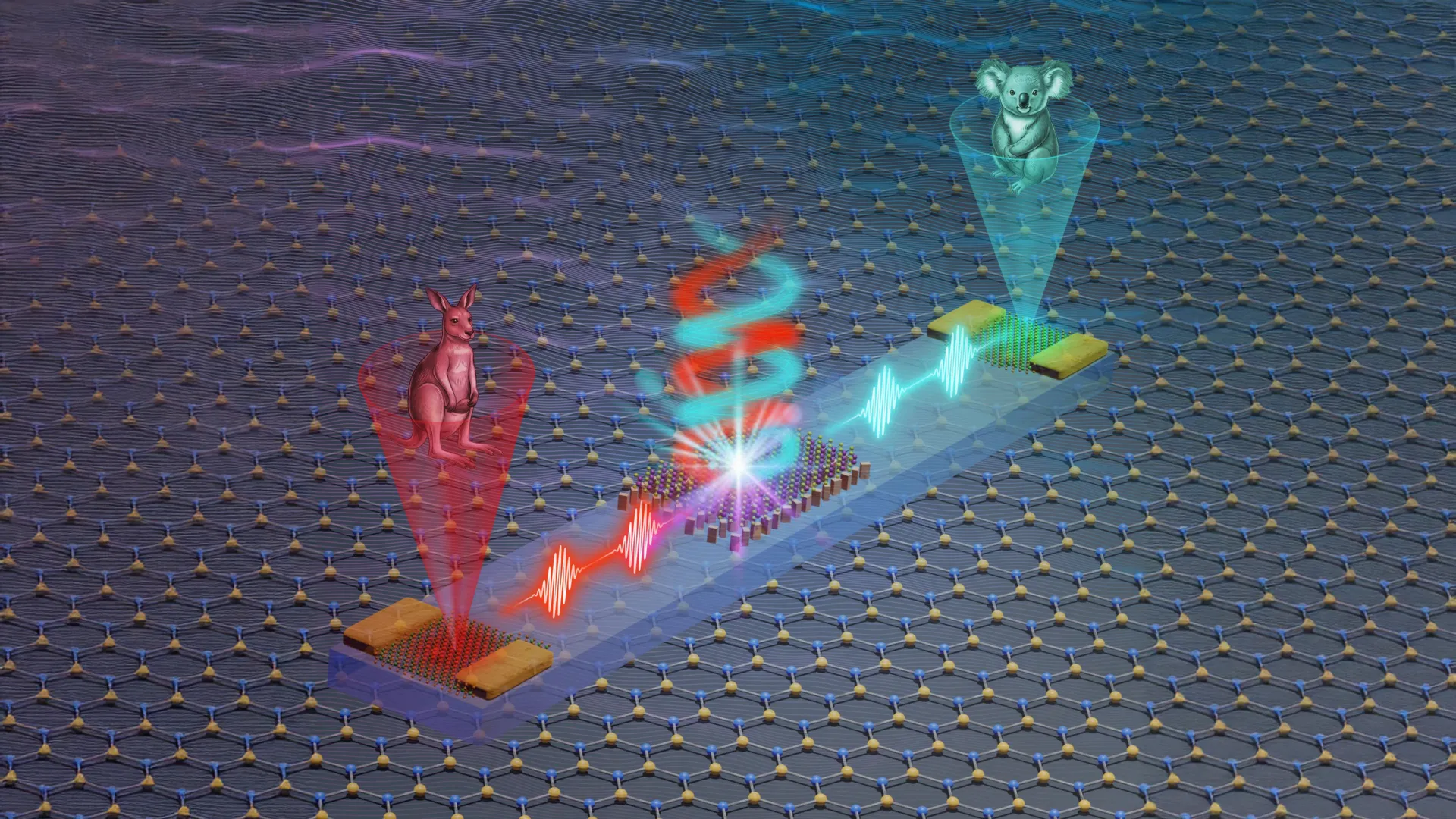
Physicists at the University of Pennsylvania have demonstrated all-optical signal switching using just four femtojoules of energy — about 4 quadrillionths of a joule — by trapping hybrid light-matter quasiparticles called exciton-polaritons in nanoscale cavities etched into atomically thin semiconductors. The advance, published this month in Physical Review Letters, takes direct aim at one of the biggest bottlenecks in photonic computing: light particles ordinarily refuse to interact with one another, forcing today's photonic chips to convert signals back to electricity to perform the nonlinear operations that make computation possible.
The work was led by Bo Zhen, the Jin K. Lee Presidential Associate Professor of Physics and Astronomy in Penn's School of Arts and Sciences, with first author Zhi Wang. The paper, titled "Strongly Nonlinear Nanocavity Exciton Polaritons in Gate-Tunable Monolayer Semiconductors" (DOI: 10.1103/gc15-qsvf), describes how the team coupled photons into nanocavities that confine light to volumes smaller than a wavelength and then drove those photons to mix with electronic excitations in monolayer semiconductors such as tungsten diselenide. The resulting quasiparticles — exciton-polaritons — inherit the speed of light from their photonic half and the strong interactions of matter from their electronic half.
The energy figure is the key result. Conventional photonic chips perform nonlinear operations at picojoule scales, roughly a thousand times the energy budget reported by Penn. Electrical transistors used in today's AI accelerators consume even more, with the GPUs that train frontier language models drawing on the order of nanojoules per logic operation across millions of gates. By pushing the energy floor down by three orders of magnitude, the Penn architecture in principle clears the way for cameras that process light directly through photonic logic without ever converting to electronic signals, and for matrix-multiplication accelerators that operate entirely on photons.
Co-author Wang told reporters the team's design exploits the gate-tunability of two-dimensional semiconductors to bring the exciton resonance into and out of alignment with the photonic mode in real time. That tunability is the practical breakthrough: previous demonstrations of exciton-polariton nonlinearity required cryogenic temperatures, large cavities or fixed materials. The Penn platform integrates with existing complementary metal-oxide-semiconductor (CMOS) fabrication and operates at temperatures within reach of standard laboratory cooling, putting it on the same engineering path as commercial silicon photonics.
Outside experts at MIT and Stanford described the result as one of the most promising recent demonstrations that photonic AI accelerators can match the energy efficiency electronics have struggled to deliver as Moore's Law slows. The U.S. Department of Energy estimated last year that AI workloads could consume 12 percent of all U.S. electricity by 2030 if current efficiency trends hold, a forecast that has driven new investment into optical computing across NVIDIA, Intel, Lightmatter and Q.ANT. Penn's exciton-polariton architecture will not produce shipping silicon for several years, but with the central physics now demonstrated, the work places the university near the front of a race the entire AI hardware industry is now running.