McGill Scientists Engineer 'Click Clotting' Blood Clots That Are 13 Times Tougher Than Natural Ones
A rapid chemical reaction crosslinks red blood cells in seconds, producing engineered clots that stop massive bleeding and could remake battlefield trauma care, Nature reports.
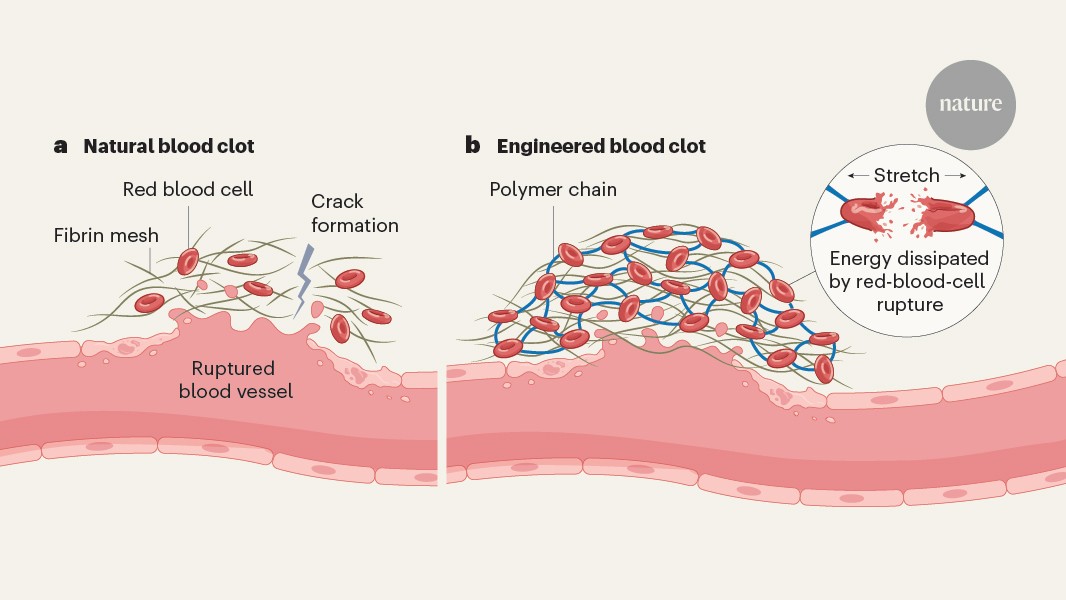
Researchers at McGill University have developed a way to engineer artificial blood clots that form in seconds, are 13 times tougher than natural clots and bond four times more securely to wounded tissue — a breakthrough that could transform emergency trauma care, surgical hemostasis and wound healing for millions of patients each year.
The technique, described in a paper published in Nature this month, has been nicknamed "click clotting" because it uses a rapid, biocompatible chemical reaction to crosslink the surface proteins of red blood cells into a tough mesh that traps platelets and fibrin within seconds of application. The team, led by Jianyu Li of McGill's Department of Bioengineering, reports that the resulting "engineered blood clots" exhibit a 13-fold increase in fracture toughness and a 4-fold improvement in adhesion energy compared with native clots formed by the body's own coagulation cascade.
The toughening mechanism is unusual. Rather than simply gluing red blood cells together — an approach earlier researchers attempted using chitosan, a polymer derived from crustacean shells, with brittle and inconsistent results — the McGill team's chemistry tolerates the controlled rupture of cells under stress. When the clot is pulled apart, individual cells release their cytoplasm in a way that dissipates energy across the structure, the same principle that makes nacre, the iridescent inner layer of mollusk shells, so resistant to fracture.
"You can think of each red blood cell as a tiny shock absorber," Li said in an interview. "When the clot stretches, the cells deform and even break in a controlled way, soaking up the energy. The whole structure ends up far stronger than the sum of its parts." In rat liver-laceration trials, the engineered clots stopped massive bleeding in under ten seconds and remained adherent for at least 30 days, during which surrounding tissue regenerated normally with no measurable inflammatory response.
The most promising near-term application is on the battlefield and at the scene of road accidents, where uncontrolled hemorrhage from a single major wound can kill a patient before they reach a hospital. Existing hemostatic dressings such as QuikClot and Combat Gauze act mostly by absorption and pressure; click-clotting agents would actively form a structural seal and could in principle be deposited by an aerosol spray. Co-author Reza Rafat said the lab has begun talks with Defense Advanced Research Projects Agency (DARPA) program managers about combat-trauma testing.
Beyond emergency use, the team sees applications in vascular surgery, where the failure of native clots is a leading cause of post-operative complications, and in regenerative medicine, where the tough scaffolding of an engineered clot could serve as a template for tissue regrowth. Translation to human use will require large-animal trials and Food and Drug Administration approval — a process the authors estimate at five to seven years. Nature's editors, in an accompanying news article, called the work "a rare example of a basic-science finding with a clear, near-term path from bench to bedside."
Originally reported by Nature.