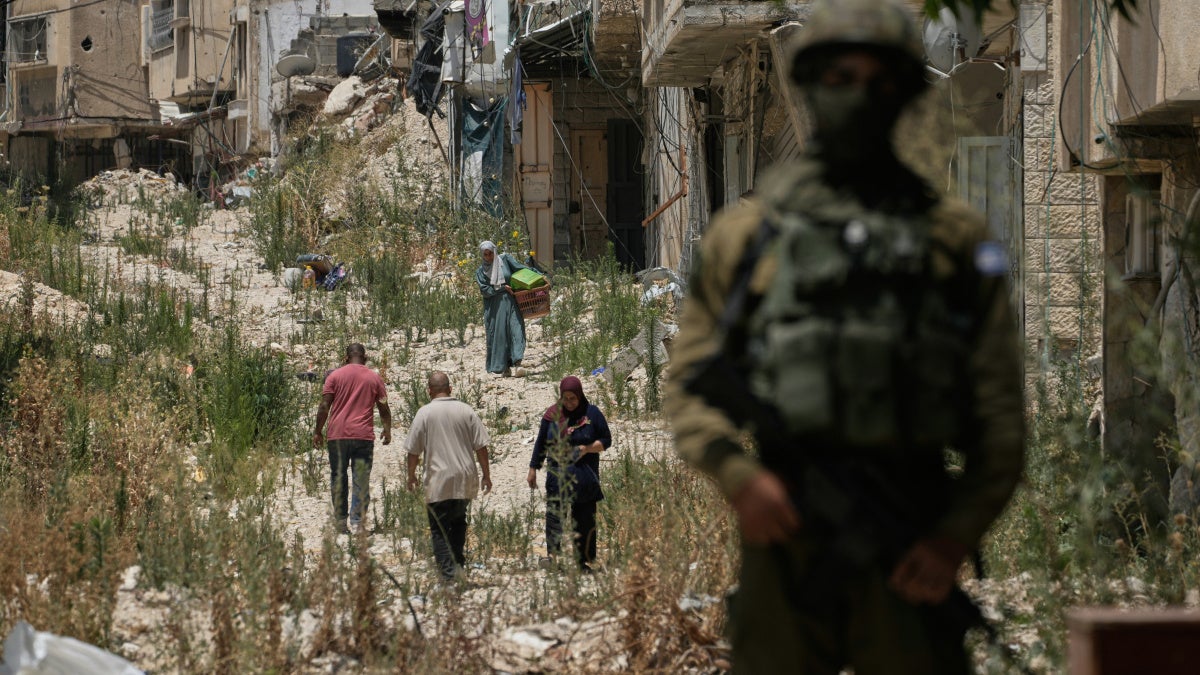
Israel Accelerates Home Demolitions in East Jerusalem's Silwan, With Rights Groups Saying 1,450 Palestinians Now Face Expulsion From Their Homes
B'Tselem says Israeli authorities have issued sweeping demolition orders covering the entire al-Bustan section of the 20,000-resident Palestinian neighborhood since the war with Iran began, with U.N. experts warning the campaign 'amounts to ethnic cleansing.'

Israeli authorities have dramatically accelerated the issuance of demolition orders against Palestinian homes in East Jerusalem since the country went to war with Iran six weeks ago, with the densest concentration of new orders falling on Silwan, a Palestinian neighborhood of about 20,000 people that hugs the southern wall of the Old City. The Israeli human rights organization B'Tselem said in a report released Monday that 1,450 residents of the al-Bustan section of Silwan now face expulsion under outstanding orders, and that 48 homes in al-Bustan alone have been demolished since 2023, including 11 in the past five weeks.
"What we are seeing in Silwan is not enforcement of building codes — it is the engineered destruction of a neighborhood," said Hagai El-Ad, B'Tselem's senior researcher on Jerusalem. The group accuses the government of Prime Minister Benjamin Netanyahu, which includes Finance Minister Bezalel Smotrich and National Security Minister Itamar Ben-Gvir — both West Bank settlers themselves — of using the cover of the Iran war and the continuing operations in Gaza to drive demographic change inside the city's boundaries while international attention is elsewhere.
A panel of U.N. independent human rights experts issued a parallel statement Monday calling the demolitions and the parallel campaign of administrative evictions "a coercive environment that amounts to ethnic cleansing." The experts, who include the Special Rapporteurs on adequate housing and on the Palestinian territories, said that of the 313 demolition orders issued by the Jerusalem municipality since the war began on April 6, 84% target Palestinian-owned structures despite Palestinians making up about 38% of the city's population. The Israeli government rejects that framing and says demolitions are carried out only against structures built without permits — a category that, Palestinian residents argue, encompasses nearly every Palestinian home in the city because the municipality has approved fewer than 100 building permits for East Jerusalem Palestinians in the last decade.
Silwan sits on land that the Bible and Jewish tradition associate with the original "City of David," and an Israeli settler organization called Elad has, for two decades, operated an archaeological park inside the neighborhood that has steadily displaced Palestinian families. Court filings reviewed by NPR show that Elad has acquired or laid claim to at least 75 Palestinian properties in Silwan since 2005, often through purchase contracts with absent Jordanian-era owners that residents say they were never notified of. "They are creating facts on the ground that no future negotiation can reverse," said Fakhri Abu Diab, a Silwan community leader whose own home was demolished in February 2024 and who now lives in a relative's basement.
The Israeli prime minister's office did not respond to a request for comment Monday. Jerusalem Mayor Moshe Lion's spokesman, Avi Tiomkin, said in a written statement that the municipality "enforces planning law without distinction between sectors" and that "the systematic illegal construction in Silwan poses safety and infrastructure risks that require action." The U.S. State Department, asked Monday whether the Trump administration would publicly comment on the accelerated demolitions, said only that "we continue to encourage all parties to refrain from unilateral steps that complicate the path to a negotiated peace."